
Jask
Intro
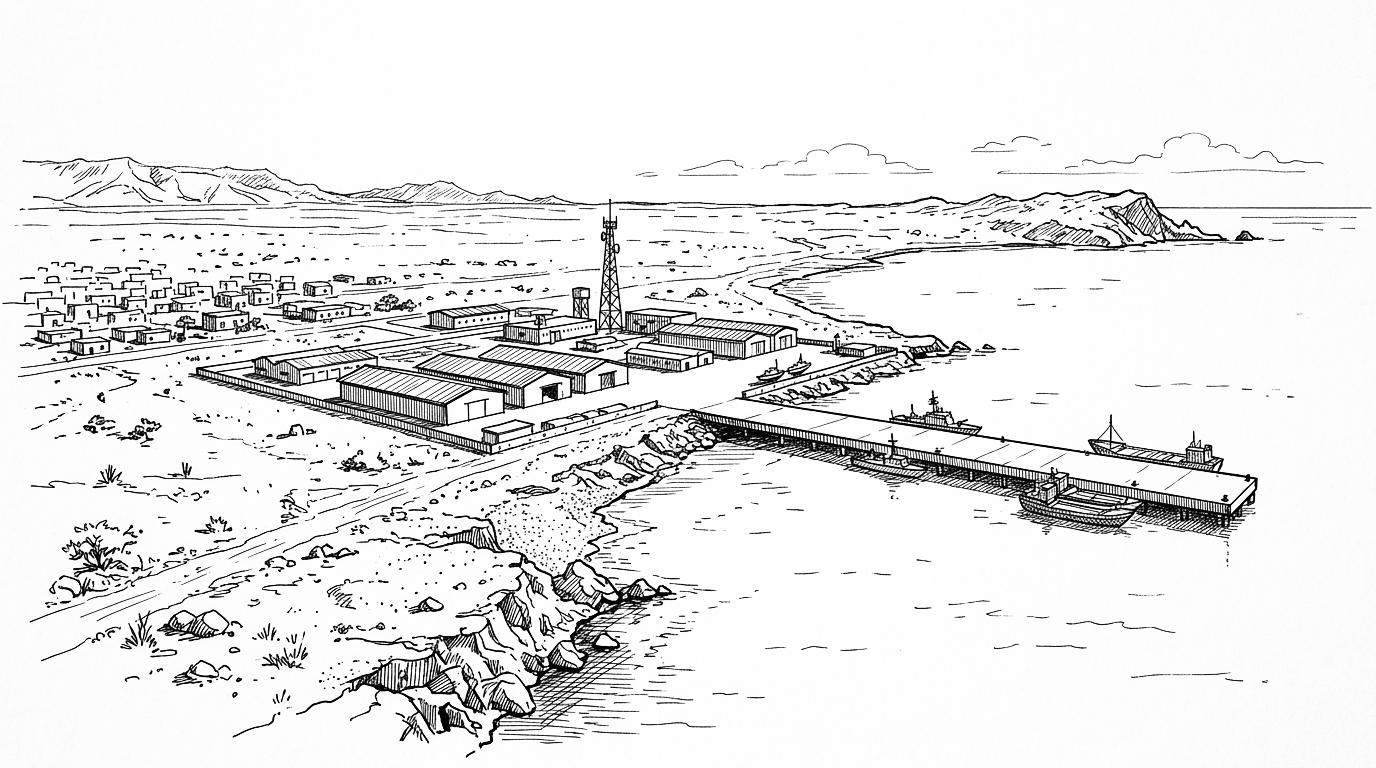
Located east of the Strait of Hormuz, Jask provides Iran with direct access to the Indian Ocean. Its development reflects a deliberate strategy to reduce exposure to chokepoint risk in the Persian Gulf.
Background
Jask’s strategic value increased sharply with the construction of the Goreh-Jask pipeline, enabling crude oil exports directly to the open ocean. The site is embedded in Iran’s long-term contingency planning for Gulf escalation scenarios.
History
Jask was a minor fishing port on the Gulf of Oman with minimal strategic infrastructure until the 2010s, when Iran identified it as the terminus for a crude oil pipeline designed to bypass the Strait of Hormuz. The Goreh-Jask pipeline was inaugurated in 2021, allowing Iran to load supertankers on the Indian Ocean coast without their passing through the strategically vulnerable chokepoint.
Simultaneously the IRGC Navy has developed a significant naval base at Jask, extending Iranian maritime power beyond the Strait. Together the oil terminal and the naval base have transformed Jask from a fishing village into a node in Iran’s strategic architecture for projecting power and securing export revenue under conditions of potential blockade.
Present Day
Today Jask hosts oil storage tanks, export terminals, naval facilities, and hardened security infrastructure. It is one of Iran’s most strategically sensitive energy locations, central to resilience planning under sanctions or conflict.
Future Outlook
Map
Articles

Why Iran Is Running Out of Water
Iran’s water crisis is driven by groundwater depletion, inefficient agriculture, and climate stress.

Iran’s Retaliation in Cold War Mode
How Tehran could turn confrontation in the Gulf into a strategic cost trap.
Event Timeline
Israeli Strikes in Tehran Killing Larijani
On the night of 16-17 March 2026, Israeli airstrikes in the Tehran area killed Ali Larijani (Secretary of the Supreme National Security Council and de facto leader) and Gholamreza Soleimani (commander of Iran’s internal Basij militia).

Nationalisation of Iranian Oil and the Mossadegh Crisis
From 1951 to 1953, Iran nationalized its oil industry under Prime Minister Mossadegh, leading to an international crisis and the eventual 1953 coup.

Iran Hostage Crisis
In 1979, Iranian students seized the U.S. Embassy in Tehran, holding 52 Americans hostage for 444 days and transforming U.S.-Iran relations.


Iranian Revolution
In 1979, a mass movement removed the Pahlavi monarchy and established the Islamic Republic, redefining Iran’s political and ideological system.

Reform Movement and the Khatami Presidency
From 1997 to 2005, Iran experienced a reform era focused on civic openness, political participation, and institutional debate.

The Green Movement
In 2009, large-scale protests challenged the presidential election outcome, marking one of the most significant political mobilizations since 1979.
Collapse of the Safavid Order and Afghan Conquest of Isfahan
In 1722, Afghan forces from Kandahar captured Isfahan, ending effective Safavid rule and opening a prolonged phase of political fragmentation across Iran.


