How Tehran could turn confrontation in the Gulf into a strategic cost trap.
Key Takeaways
- Iran is unlikely to seek victory through conventional warfare. The United States and Israel retain overwhelming superiority in air and naval power, making a direct military contest strategically unfavorable for Tehran.
- Iran’s leverage lies in geography and asymmetric capabilities. Control of the Strait of Hormuz, large missile inventories, and inexpensive drone production allow Tehran to exert pressure on regional infrastructure and shipping without engaging in decisive battles.
- Missile warfare creates a structural cost imbalance. Relatively cheap drones and missiles can force defenders to expend interceptor systems costing several million dollars each, gradually turning defense into an expensive and resource-intensive task.
- The resulting confrontation could resemble a Cold War–style attrition dynamic. In such a scenario the decisive variable becomes endurance—industrial production, financial capacity, and political stamina—rather than conventional battlefield dominance.
The Current Situation
The confrontation between Iran, Israel, and the United States has entered a phase in which retaliation is no longer hypothetical. Military strikes, regional mobilization, and escalating rhetoric have pushed the crisis beyond the level of isolated incidents. The question is no longer whether Iran will respond, but how it will choose to do so.
Any assessment of Iranian retaliation must begin with a basic observation. Iran is not facing a conventional military balance in which victory can be achieved through direct confrontation. The United States retains overwhelming naval and air superiority, while Israel possesses one of the most capable air forces in the region. A direct military contest would therefore favor the Western coalition.
Yet conflicts are rarely decided by theoretical strength alone. Geography, logistics, infrastructure, and political endurance often matter as much as military hardware. In the case of Iran, these structural factors shape the range of responses available to the regime.
Broad Horizon Nexus
 © 2026 – Broad Horizon
The Iranian System
A recurring mistake in Western analysis is the assumption that regimes such as Iran’s operate irrationally or incompetently simply because they are authoritarian. This assumption can obscure the strategic logic that has shaped Iranian policy for decades.
Since the revolution of 1979 the Islamic Republic has evolved under conditions of sanctions, diplomatic isolation, and intermittent confrontation with external powers. Over time this environment produced a system designed for resilience rather than rapid development. Political authority is distributed across several institutions — the presidency, parliament, clerical bodies, and security organizations — yet strategic direction ultimately rests with a smaller circle closely tied to the security apparatus.
In practice this structure allows the regime to absorb external pressure while maintaining internal control. Decisions about escalation are rarely impulsive. They tend to emerge from calculations that weigh political survival, domestic stability, and regional influence.
In simplified terms, Iran’s political system operates through a layered structure of authority, coordination, and operational power.
| Element | Role in the system | Strategic relevance |
|---|---|---|
| Supreme Leader | Ultimate political and military authority | Final decision-maker on war and national security |
| Supreme National Security Council (SNSC) | Strategic coordination body for national security | Aligns military, intelligence, and foreign policy decisions |
| President & Government | Executive administration | Manages the state apparatus and economic policy |
| Islamic Revolutionary Guard Corps (IRGC) | Parallel military, intelligence and economic structure | Controls missile forces, regional networks and strategic industries |
| Regular Army (Artesh) | Conventional armed forces | Territorial defence and conventional warfare |
| Basij Mobilization | Paramilitary mobilization network | Internal control and potential mass mobilization |
The individuals occupying these positions are often highly experienced in their respective fields, many with international exposure and long careers within Iran’s political and security institutions.
Much of Iran’s strategic coordination appears to run through the Supreme National Security Council, where veteran power broker Ali Larijani serves as secretary and key coordinator of national security policy.
Iran’s Leaders
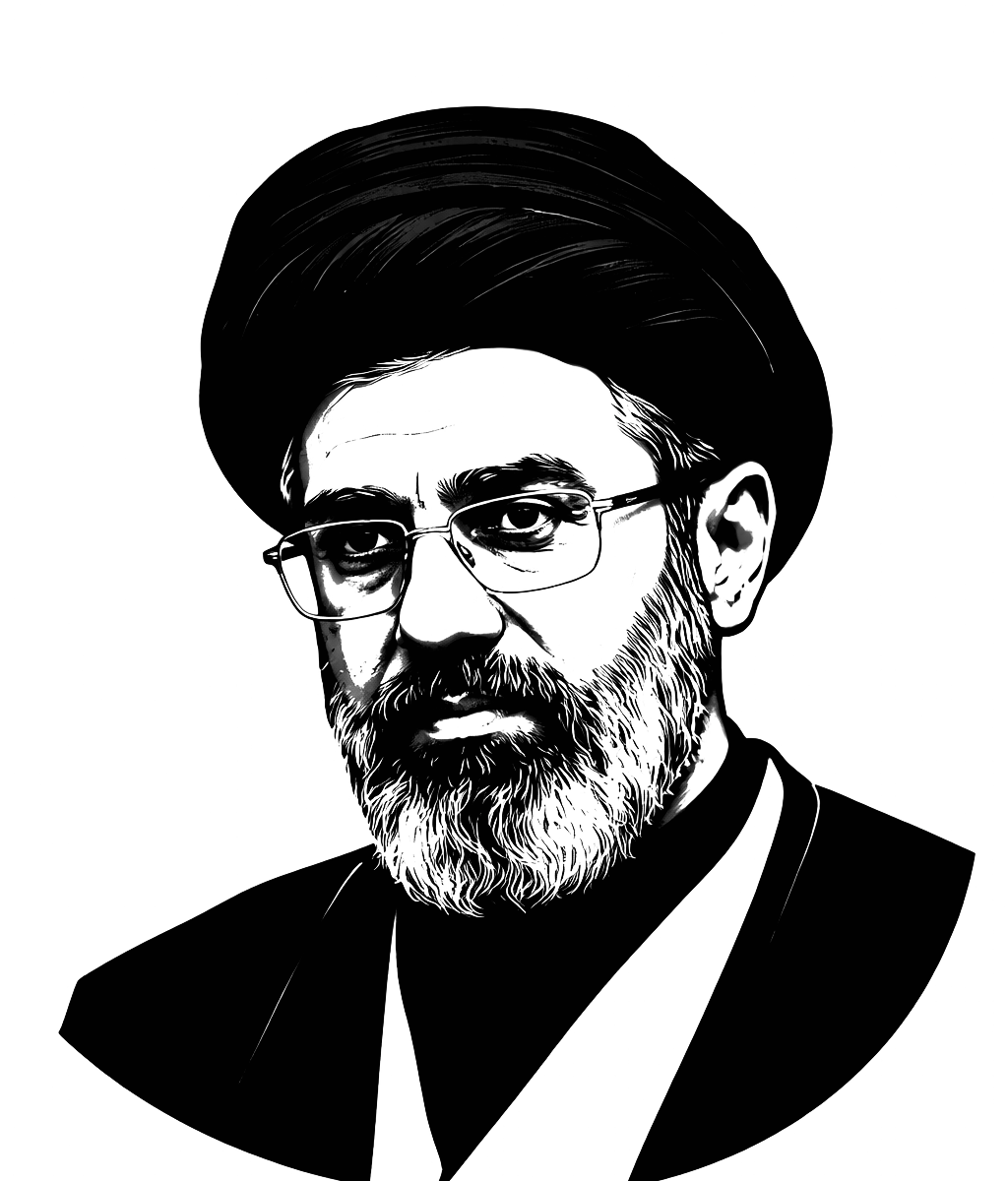
Mojtaba Khamenei
Supreme Leader of the Islamic Republic of Iran (since 9 March 2026); son of Ali Khamenei (d. 2026)

Ali Larijani
Former Speaker of Parliament; conservative

Masoud Pezeshkian
President of Iran
This layered structure allows the Iranian state to absorb external pressure while maintaining strategic continuity, even during prolonged confrontation.
The Regional Landscape
The confrontation around Iran does not take place in a simple two-sided conflict. The Middle East today is a dense network of alliances, rivalries, and overlapping interests.
The United States and Israel form the core military partnership confronting Iran. Several Gulf states maintain close security cooperation with Washington and host major American military installations. At the same time many of these states are cautious about becoming direct participants in a broader war, given their proximity to Iranian missile forces and energy infrastructure.
Other regional actors occupy more ambiguous positions. Turkey seeks to preserve its regional influence while avoiding direct escalation. Iraq remains politically fragmented and strategically exposed. Syria and non-state groups aligned with Iran could provide additional channels for indirect confrontation.
Beyond the region, major powers such as Russia and China watch the situation closely. Neither has an interest in a large regional war, but both maintain strategic relations with Tehran and could influence the diplomatic environment surrounding the conflict.
| Actor | Position | Strategic interest |
|---|---|---|
| United States | Military presence across Gulf | Protect shipping lanes and regional allies |
| Israel | Direct adversary of Iran | Prevent Iranian military expansion |
| Saudi Arabia | Security partner of US | Protect oil infrastructure |
| United Arab Emirates | Security cooperation with US | Stability of trade and energy flows |
| Qatar | Host of major US bases | Strategic balancing role |
| Turkey | Independent regional actor | Avoid large regional war |
| Iraq | Politically fragmented | Strategic corridor between Iran and the Levant |
| Russia | Strategic partner of Iran | Balance Western influence |
| China | Economic partner | Secure energy imports |
The Balance of Available Power
Measured in conventional terms, the military balance favors the United States and Israel. American forces in the region include carrier strike groups, advanced missile-defense systems, and long-range strike capabilities, while Israel fields hundreds of modern combat aircraft and a layered air-defense network.
Iran’s conventional forces are more limited. Its air force relies heavily on older aircraft and its navy is modest compared with the U.S. fleet operating in the Gulf.
Yet Iran compensates through other capabilities. The country maintains large inventories of ballistic missiles and cruise missiles, extensive drone production, and naval forces specifically designed for operations in the confined waters of the Persian Gulf. Iran also controls the northern coastline of the Strait of Hormuz, one of the most critical energy chokepoints in the world.
These factors do not erase the military imbalance, but they shape the strategic environment in which retaliation will occur.
| Capability | United States / Israel | Iran |
|---|---|---|
| Air power | Strong conventional superiority | Limited, older fleet |
| Missile defense | Patriot, THAAD, Arrow, Iron Dome | Limited layered defense |
| Naval power | Carrier groups, destroyers, submarines | Fast attack craft, mines, coastal missiles |
| Ballistic missiles | Limited regional role | Large inventory |
| Cruise missiles | Large inventory | Significant regional capability |
| Drones | Advanced systems | Large and relatively cheap fleet |
| Geography | Expeditionary position | Home-field advantage, Hormuz control |
The balance favors the United States and Israel in conventional warfare, but Iran retains leverage through geography, missile inventories, and asymmetric capabilities.
Possible Forms of Iranian Retaliation
Several forms of retaliation are theoretically available to Iran. Due to the lack of a strong air force support the ground troops of Iran are more vulnurable. However, the fact that Iran has a large professional army, and stockpiles of ammunition and missiles could make a ground operation (Blitzkrieg) against Kuwait, Bahrain, the United Arab Emirates or even Oman (the horn) a possibility.
That all depends on how powerful the army really is. If the Naval Force is still operational and what the goal of it would be. Occupation is unlikely, but a total destruction of US infrastructure and military capacities – or oil and gas installations will help strengthen the position of Iran in the region.
A conventional invasion of Gulf states such as Kuwait or Bahrain would be extremely risky though, and would likely provoke overwhelming military response. A direct attempt to defeat American naval forces would face similar constraints.
More plausible options rely on geography, missiles, and gradual escalation rather than decisive confrontation.
One possibility is maritime disruption. Iran controls the northern coastline of the Persian Gulf and the Strait of Hormuz. Even limited harassment of shipping, naval mines, or periodic attacks on tankers could slow energy flows and increase insurance costs without requiring sustained combat operations.
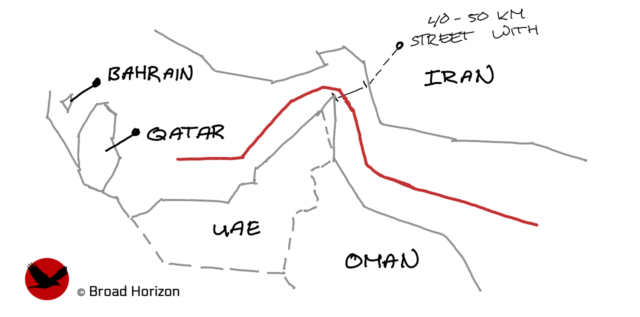
Strategic map of the Persian Gulf showing Iranian coastline, the Strait of Hormuz chokepoint, Gulf energy infrastructure, and major U.S. military installations.
Another possibility is periodic missile and drone strikes against military bases or energy infrastructure in the Gulf. Such attacks do not need to be continuous. A limited number of launches every few days may already be sufficient to keep defensive systems active and maintain pressure on regional infrastructure.
| Retaliation option | Likelihood | Strategic purpose |
|---|---|---|
| Maritime disruption | High | Pressure shipping and energy markets |
| Missile and drone strikes | High | Impose cost and uncertainty |
| Proxy escalation | Medium | Expand pressure without full direct war |
| Ground move into Gulf states | Low | High risk, limited necessity |
Iran does not need to win a conventional war. It only needs to maintain enough pressure that the conflict becomes expensive to sustain. Missile inventories, inexpensive drones, and geographic control of the Strait of Hormuz make such a strategy possible.
Iran could also combine this with indirect escalation through regional networks, allowing attacks to occur across multiple locations rather than a single battlefield.
None of these options produces a decisive victory. Their purpose would instead be to create an environment of persistent uncertainty in which the United States and its partners must maintain a large and expensive defensive presence across the region.
⸻
Cost Asymmetry in Missile and Air Defense Warfare
One of the most important dynamics in a potential confrontation between Iran and the United States is the cost imbalance between attack and defense. Modern air-defense systems are highly effective, but they are also extremely expensive to operate. In many cases, relatively cheap weapons can force the defender to deploy interceptors that cost many times more than the incoming threat.
The best example is the Patriot PAC-3 interceptor. A single interceptor missile costs roughly $3–4 million, according to U.S. procurement data and defense reporting. 
Iranian attack systems operate on a very different economic scale. The widely used Shahed-136 loitering drone is estimated to cost roughly 20,000–50,000 per unit.
Ballistic missiles are more expensive, but still often cheaper than the interceptors used against them. Estimates vary significantly depending on the missile type:
| Weapon / System | Estimated unit cost | Strategic implication |
|---|---|---|
| Iranian ballistic missile | $1–3 million | Cheap relative to interceptor systems |
| Iranian drone (Shahed-type) | $20k–50k | Mass production possible |
| Patriot interceptor | $3–5 million | Expensive defensive response |
| THAAD interceptor | $10–15 million | Strategic missile defense |
| Arrow interceptor (Israel) | $2–3 million | Ballistic missile defense |
Sources: defense analyses of Iranian missile programs and U.S. missile defense procurement data. 
This creates a structural imbalance. A relatively cheap attack can force a very expensive defensive response. Even a limited number of drones or missiles launched periodically can compel the defender to maintain constant air-defense readiness and expend high-value interceptors.
In such an environment the conflict becomes less about individual strikes and more about inventory and endurance. The side that can sustain its weapons stockpiles longer may gain the strategic advantage.
These dynamics suggest that Iranian retaliation would not necessarily aim at rapid escalation or territorial conquest. A more plausible outcome is a prolonged confrontation in which pressure is applied gradually, forcing the opposing coalition to sustain an expensive defensive posture across the region.
Iran in Cold War Mode
Iran probably cannot win a conventional war against the United States. But it may not need to. The more realistic option is to shift the conflict into a defensive cost trap.
When Iran shifts into a Cold War mode, the objective is not victory but endurance — a situation in which the stronger power simply becomes exhausted.
Iran’s strongest option is therefore not conquest but endurance. It does not need to occupy Riyadh or defeat the U.S. Navy in open battle. It only needs to keep the Gulf nervous, the Strait of Hormuz unstable, and the defenders firing expensive missiles at relatively cheap threats.
The economic dimension of missile warfare is often overlooked. In practice, the balance between offense and defense is not only technological but financial. Cheap weapons can force the defender to expend far more expensive interceptors.
| System | Estimated unit cost | Typical use | Strategic effect |
|---|---|---|---|
| Iranian ballistic missile | $1–3 million | Strike regional bases or infrastructure | Forces expensive interception |
| Iranian cruise missile | $500k–1.5 million | Precision strikes | Difficult to intercept |
| Iranian drones (Shahed-class) | $20k–50k | Saturation attacks | Cheap mass deployment |
| Patriot interceptor | $3–5 million | Missile defense | High defensive cost |
| THAAD interceptor | $10–15 million | High-altitude interception | Strategic but expensive |
| Arrow interceptor | $2–3 million | Israeli missile defense | Regional defense |
This imbalance means that even limited attacks can impose disproportionate costs on the defender. The conflict therefore becomes less about individual strikes and more about inventory, production, and endurance.
The implications become clearer when the numbers are translated into operational tempo. Even a modest level of missile defense activity can generate very large expenditure.
The danger is therefore not a dramatic regional blitzkrieg, but a colder and more durable form of attrition: a conflict in which shipping slows, insurance rises, oil infrastructure remains vulnerable, and American prestige becomes tied to an ever more expensive defensive shield. Such a war would not look like Iraq in 2003. It would look more like a long strategic drain, in which the stronger power discovers that superiority in theory is not the same thing as sustainability in practice.
The Cost Trap
Warfare is complex, but let’s make the calculation simple. The usable anchor is the Patriot.
Reuters reports PAC-3 production at roughly 600 missiles per year, while recent contracts and Army budget documents put the unit cost at about $4 million per interceptor.  Bloomberg also reported that President Zelensky said Ukraine had received about 600 PAC-3s since the full-scale Russian invasion, and separate Bloomberg reporting described Iran’s drone-and-missile campaign as an attritional fight over who runs out of munitions first.  Reuters’ live coverage further said the Trump administration estimated the Iran war had already cost the U.S. more than $11 billion in six days. 
That gives a clean scenario table.
| Patriot interceptors fired | Direct interceptor cost | Monthly burn rate | Annualized burn rate |
|---|---|---|---|
| 10 per day | $40 million / day | $1.2 billion / month | $14.6 billion / year |
| 25 per day | $100 million / day | $3.0 billion / month | $36.5 billion / year |
| 50 per day | $200 million / day | $6.0 billion / month | $73.0 billion / year |
| 100 per day | $400 million / day | $12.0 billion / month | $146.0 billion / year |
Notes
•	PAC-3 interceptor production is estimated at roughly 600 missiles per year.
•	Unit cost per interceptor is roughly $4 million.
•	The figures above represent interceptor cost only.
They exclude:
•	THAAD interceptors
•	SM-3 naval interceptors
•	Combat air patrols
•	Tanker operations
•	Carrier and naval operations
•	Tomahawk strike missions
•	Radar and launcher replacement
•	Infrastructure repair
The table therefore represents a minimum cost floor, not the total cost of sustained missile defense operations.
Even a relatively modest defensive tempo becomes expensive very quickly. At 25 Patriot interceptors per day, the annualized missile bill alone reaches roughly $36.5 billion. At 50 per day, it rises to about $73 billion, before accounting for ships, aircraft, fuel, maintenance, and the wider military operation.
If the current rate of defensive fire is even broadly close to the figures now circulating in Western reporting, the Gulf campaign is consuming Patriot interceptors at a pace that makes the Ukraine war look restrained by comparison. 
This is the real Iranian option. Not victory in the classic sense, but strategic prolongation. A regime under pressure can still force the stronger side into a pattern of expensive defense, recurring disruption, and political fatigue. In that model, the decisive variable is no longer battlefield dominance but the cost of maintaining order. And that is precisely where geography, missiles, drones, and the Strait of Hormuz give Tehran its leverage.
The People’s Suffering from the Emperors’ War
One final element should not be overlooked. A prolonged confrontation would not only affect global energy markets and regional stability; it would also deepen the internal pressures already facing Iran itself. Years of sanctions and economic isolation have strained the country’s economy and infrastructure. Environmental challenges — including severe water shortages across large parts of the country — are already creating long-term humanitarian risks. A shift toward a prolonged confrontation with the outside world could push Iran further into isolation, leaving the population to bear the consequences of a conflict they did not choose.
⸻
Appendix A – Energy Chokepoints
Energy chokepoints in the region.
| Location | Strategic role | Estimated share of global energy flow | Vulnerability |
|---|---|---|---|
| Strait of Hormuz | Main export corridor for Gulf oil and LNG | ~20–25% of global oil trade | Very high |
| Ras Tanura (Saudi Arabia) | Major Saudi export terminal | Largest oil export facility in the world | Medium |
| Fujairah (UAE) | Key bypass port outside Hormuz | Important storage and export hub | Medium |
| Qatar LNG terminals | Global LNG supply hub | ~20% of global LNG trade | High |
| Kuwaiti export terminals | Northern Gulf oil export | Critical for Kuwaiti economy | High |
| Bahrain refinery hub | Processing and distribution | Regional importance | Medium |
Appendix B – Missile Production vs Interceptor Consumption
The deeper issue behind these figures is not a single engagement but the industrial balance of the conflict. Missile warfare increasingly resembles an attrition contest between production capacity and defensive consumption.
Missile warfare increasingly becomes a contest between production capacity and defensive consumption. The table below compares estimated production and cost structures for offensive weapons and interceptor systems.
| System | Estimated unit cost | Estimated annual production | Strategic implication |
|---|---|---|---|
| Iranian ballistic missiles | $1–3 million | Unknown, but likely hundreds per year | Lower cost than interceptor systems |
| Iranian cruise missiles | $500k–1.5 million | Hundreds per year possible | Difficult interception profile |
| Iranian drones (Shahed-type) | $20k–50k | Thousands per year | Saturation capability |
| Patriot PAC-3 interceptor | ~$4 million | ~600 per year | Limited production capacity |
| THAAD interceptor | $10–15 million | Limited production | Strategic missile defense only |
| SM-3 interceptor | $10–20 million | Limited production | Naval ballistic missile defense |
Even approximate figures show the imbalance: relatively cheap attack systems can force defenders to expend expensive interceptors.
Attrition Balance Scenario
The next table illustrates how this imbalance translates into operational tempo during a sustained missile campaign.
| Scenario | Iranian weapons launched per month | Defensive interceptors required | Production sustainability |
|---|---|---|---|
| Limited pressure campaign | 100–200 | 120–240 | Sustainable for both sides |
| Sustained regional pressure | 300–500 | 360–600 | Approaches annual Patriot production |
| High attrition campaign | 800–1,000 | 900–1,200 | Defender begins to face supply limits |
Once interceptor demand approaches annual production capacity, defensive sustainability becomes the central strategic constraint.
Operational Cost Illustration
The financial dimension of this imbalance can also be illustrated through simplified operational scenarios.
| Scenario | Missiles / drones launched per month | Defensive interceptors required | Estimated defense cost |
|---|---|---|---|
| Low intensity pressure | 30–50 | 40–60 | $150–300 million |
| Medium sustained campaign | 100–150 | 120–180 | $600 million – $1 billion |
| High saturation attacks | 300+ | 350–450 | $2–4 billion |
Strategic interpretation
The structural difference between offensive and defensive systems can therefore shape the long-term dynamics of the conflict.
| Factor | Iran | United States / Allies |
|---|---|---|
| Cost per weapon | Low | High |
| Production capacity | Scalable | Industrially limited |
| Operational strategy | Saturation and persistence | Interception and protection |
| Long-term dynamic | Attritional pressure | Expensive defense posture |
In such a scenario, the conflict becomes less about individual strikes and more about industrial capacity, inventory levels, and economic endurance.
| Actor | Typical attack cost | Typical defensive cost | Result |
|---|---|---|---|
| Iran | $20k–3 million per weapon | — | Low-cost pressure |
| United States / allies | — | $3–15 million per interception | Expensive defense |
Implication: Even without achieving decisive military victory, Iran could sustain a cost-imposing strategy, forcing adversaries to expend far more resources defending against relatively inexpensive attacks.
Appendix C – Patriot Stock Depletion
The final constraint is industrial production. Even the most advanced interceptor systems can only be manufactured at a limited rate, which places a hard ceiling on how long high-intensity missile defense can be sustained.
Assumption: annual PAC-3 production ≈ 600 interceptors
| Interceptors fired per day | Interceptors used per month | Interceptors used per year | Relation to annual production | Strategic implication |
|---|---|---|---|---|
| 10 | ~300 | ~3,650 | 6× annual production | Unsustainable without stockpiles |
| 25 | ~750 | ~9,125 | 15× annual production | Rapid depletion of inventories |
| 50 | ~1,500 | ~18,250 | 30× annual production | Missile defense cannot be sustained |
| 100 | ~3,000 | ~36,500 | 60× annual production | Industrial scale mismatch |
Strategic Interpretation
| Factor | Observation |
|---|---|
| Annual PAC-3 production | ~600 interceptors |
| Moderate conflict usage | Several thousand interceptors per year |
| Production vs usage gap | Large structural imbalance |
| Strategic consequence | Defense becomes an industrial endurance contest |
Even a relatively low-intensity missile campaign can therefore push missile defense systems into a logistical and financial attrition dynamic, where the defender spends far more resources than the attacker.

Download the Broad Horizon App