
Hamun Wetlands
Intro
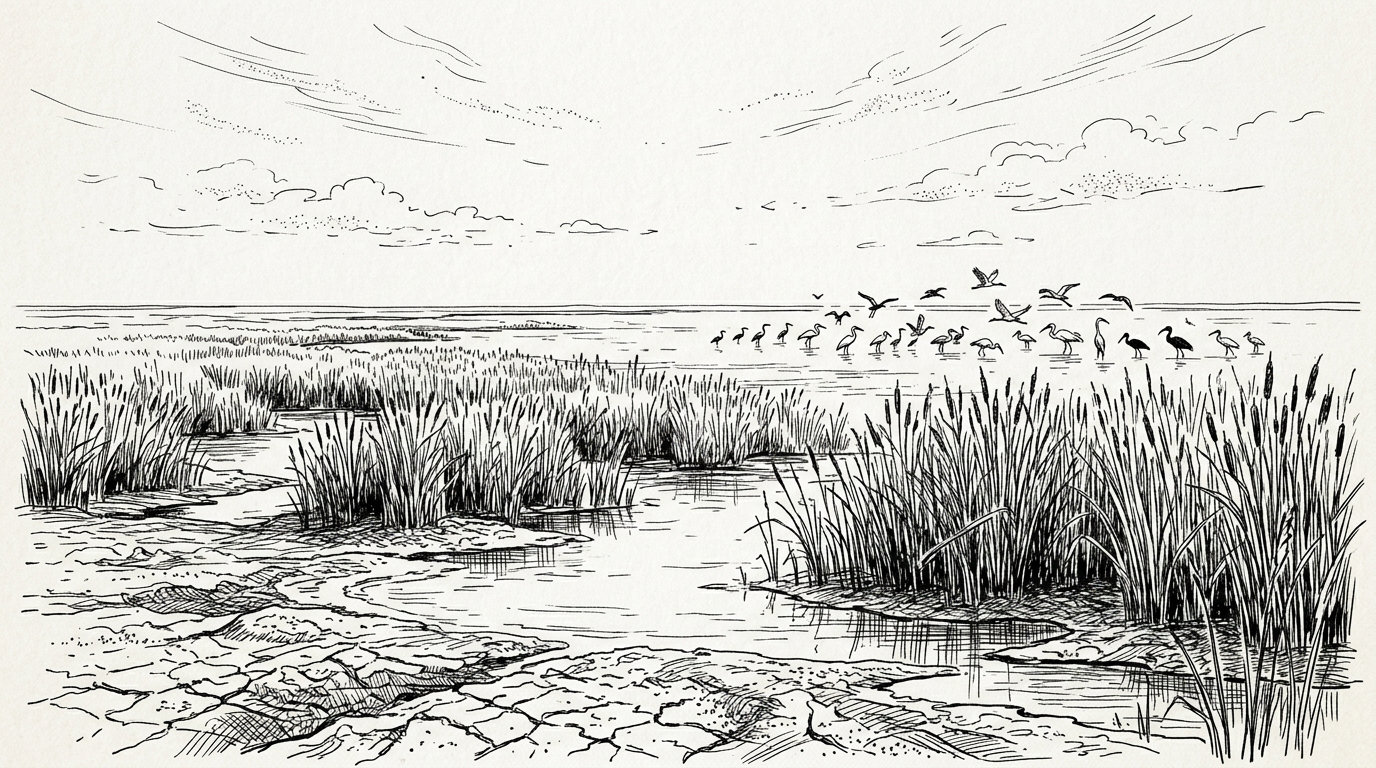
The Hamun wetlands are a system of shallow lakes in the Sistan Basin on the Iran-Afghanistan border. Historically one of the largest wetland complexes in Asia, they depend on the Helmand River flowing from Afghanistan. Prolonged drought and upstream water management have caused near-total collapse of the wetland ecosystem.
Background
History
The Hamun wetlands were among the most productive ecosystems in eastern Iran for thousands of years, supporting fishing, hunting, pastoralism, and agriculture along the shores of the shallow lakes. Ancient Sistan was one of the most densely settled regions of the Iranian world, and the Bronze Age city of Shahr-e Sukhteh on the Hamun’s western edge was one of the largest urban centres of its time. Persian, Arab, and later Mongol and Safavid rulers all recognised Sistan as a valuable agricultural and strategic region. The lakes fluctuated dramatically with the Helmand River’s seasonal flows, and periods of drought or upstream diversion caused periodic collapses of the regional economy.
Present Day
The Hamun wetlands are in a state of near-total ecological collapse. The combination of upstream dam construction in Afghanistan – particularly the Kajaki Dam and numerous smaller structures – and severe multi-year drought has reduced water flows in the Helmand to a fraction of historical levels. The lakes dried almost completely in the early 2000s and have only partially recovered in wet years. The Wind of 120 Days, a strong seasonal wind from Central Asia, drives dust storms across the dried lake beds throughout the summer, making the area around Zabol one of Iran’s most environmentally stressed regions. Rural depopulation has been extensive.
Future Outlook
Map
Articles

Why Iran Is Running Out of Water
Iran’s water crisis is driven by groundwater depletion, inefficient agriculture, and climate stress.

Iran’s Retaliation in Cold War Mode
How Tehran could turn confrontation in the Gulf into a strategic cost trap.

A European Covenant Draft for Peace in Ukraine
A complementary framework for long-term stability

Empire Thinking on Greenland
Why strategic access is sufficient — and why ownership rhetoric persists


The Hong Kong fire will change China’s Real Estate sector
China’s real estate sector is shaped by deeper pressures than market cycles alone.
Demographics, oversight consistency, due-diligence gaps and investment confidence now intersect in ways that define the sector’s next phase.

Pokrovsk: Logistics, Pressure and the Geometry of the Eastern Front
Pokrovsk has become the most stressed point on the eastern Ukrainian front.

China’s Fourth Plenum — Xi Tightens Control as Party Sets Course for the Next Five Years
Planning the future – the news between the lines.


Books To read for summer 2025
A summer reading list for those tracing the fractures of empire, freedom, and the European condition.
Event Timeline

Pereyaslav Agreement with Tsarist Russia
The Pereyaslav Agreement between the Cossack Hetmanate and Tsarist Russia marked the beginning of Ukraine’s alignment with Russia, which would evolve into centuries of political, military, and cultural influence.

Union of Lublin – Polish Lithuanian Commonwealth
Before Moscow, there was Lublin. The Polish–Lithuanian Commonwealth laid the groundwork for Western Ukrainian identity — and for centuries of contested rule.

Eurasian Peace Talks
A Summer-offensive is at hand – though strategic talks are still possible.

Crimea Annexation by Russia
In the shadow of Ukraine’s Maidan uprising, Russian forces seized control of Crimea. What followed was a swift, illegal annexation — a violation of international norms that shattered post–Cold War assumptions and launched a new era of geopolitical confrontation.

The Hanseatic League
Beginning in the 14th century, a group of northern European cities formed a commercial and legal alliance that would dominate Baltic trade for centuries. Known as the Hanseatic League, this urban confederation connected ports from Flanders to Novgorod, enabling secure trade, mutual defense, and legal cooperation without central rule.

Holodomor Famine
The Holodomor Famine was a man-made catastrophe under Stalin’s regime that devastated Ukraine, killing millions of Ukrainians and leaving a permanent scar on the national consciousness.

Ukraine’s Declaration of Independence
After decades as a Soviet republic, Ukraine asserted its sovereignty on 24 August 1991. This act of independence emerged from the ashes of empire — a democratic rebirth with fragile roots and far-reaching consequences.

Attack on Sumy, at Palm Sunday, 2025
On Palm Sunday, April 13th, 2025, Russian forces struck the Ukrainian city of Sumy, killing civilians and sending a symbolic message of hatred. The attack violated not just laws of war, but shared cultural and spiritual bonds. It stands as one of the most morally grotesque moments of the ongoing invasion.

Kievan Rus
The Founding of Kievan Rus marks the establishment of the first East Slavic state centered around Kyiv, which laid the foundations for modern Ukraine, Belarus, and Russia.


