
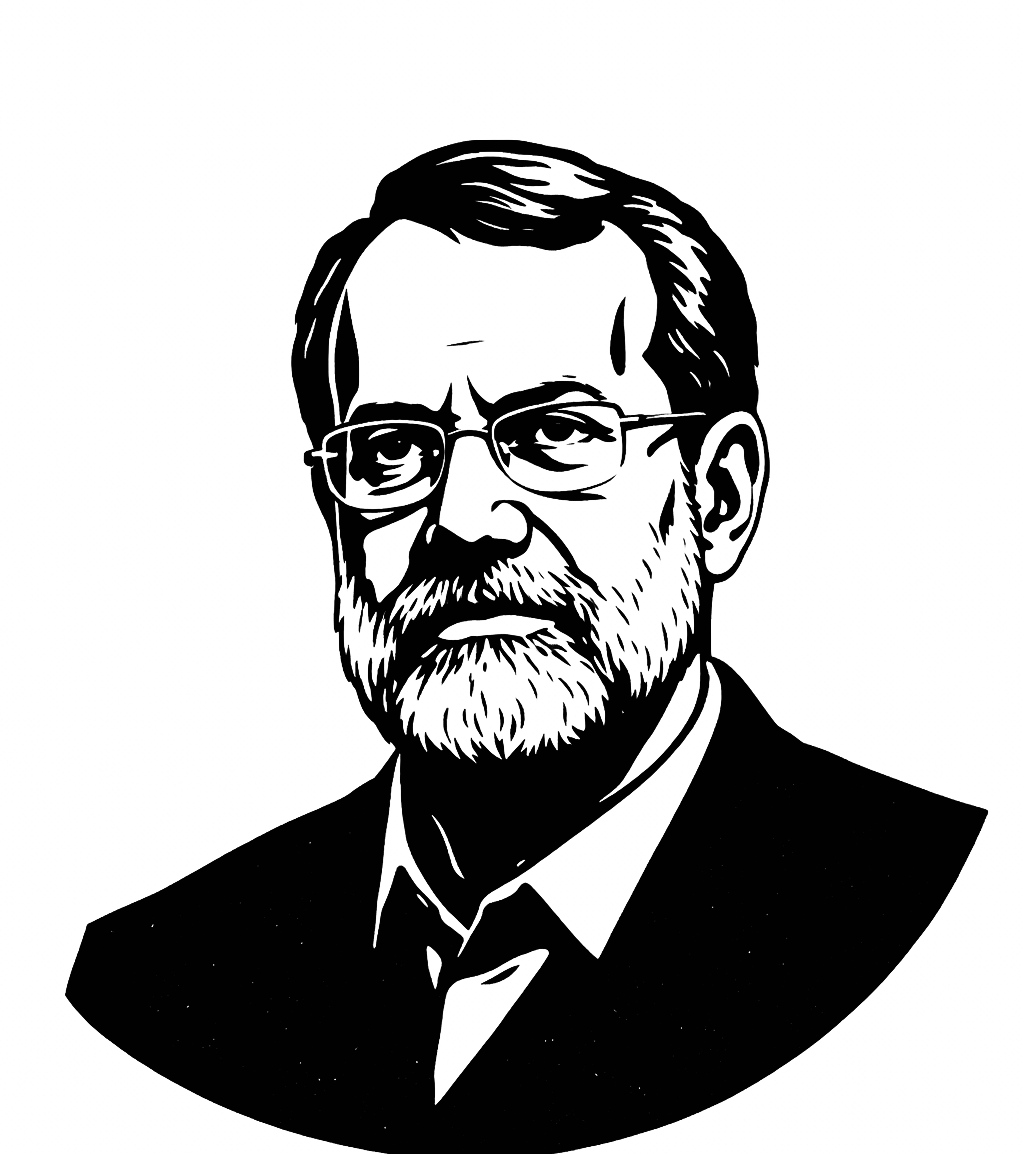
Iranian conservative politician; Speaker of Parliament (2008-2020); former Supreme National Security Council secretary; head of state broadcasting. Key power broker in Iranian politics. He was reappointed SNSC secretary (Aug 2025-Mar 2026) and was widely seen as de facto leader of Iran until his assassination in an Israeli airstrike in Tehran on 17 March 2026.
1. Origins & Formation
Born in Najaf in 1957 into the Larijani clerical-political dynasty, Ali Larijani grew up inside the networks that would later dominate the Islamic Republic’s judiciary, parliament, and security establishment. Educated in mathematics and philosophy, then trained in revolutionary politics, he built a profile that combined technocratic competence with conservative religious legitimacy.
2. Rise through the System
After 1979 he cycled through key regime institutions: the IRGC, the culture and media apparatus, and high-level security posts. As head of Islamic Republic of Iran Broadcasting (IRIB) he helped define the regime’s media narrative; later, as Secretary of the Supreme National Security Council under Ahmadinejad (2005-2007), he was the main nuclear negotiator with the EU-3 and a central interlocutor with the US on Iraq security channels.
3. Speaker & Power Broker
From 2008 to 2020 Larijani served as Speaker of Parliament, positioning himself as a pragmatic conservative who could mediate between hardliners, technocrats, and parts of the reformist camp. He protected core regime interests while occasionally criticising presidential excesses, building a reputation as a deal-maker with deep knowledge of the system’s institutional wiring. His speakership ended when harder-line factions consolidated control and shut him out of key candidate lists.
4. Worldview & Inner Logic
Fear driver: uncontrolled street politics that could dissolve the Islamic Republic. Ego driver: being recognised as a strategic mind and institutional architect rather than a mere factional operative. Belief driver: preserving the Islamic system through calibrated compromise with external powers and managed pluralism at home. Identity driver: a regime insider from a multi-node family network (judiciary, parliament, Guardian Council) who sees himself as guardian of order rather than revolutionary vanguard.
5. Networks & Factional Role
Larijani sits at the intersection of conservative clerical networks, security elites, and business-bureaucratic technocrats. He has worked closely with figures in the Supreme Leader’s office while at times clashing with more ideological hardliners. His extended family’s presence across the judiciary (Sadeq Larijani), parliament, and advisory councils makes him a nodal point in elite bargaining, even when out of formal office.
6. Succession Relevance
As a member of the Assembly of Experts and long-time insider, Larijani is one of the figures who could shape the post-Khamenei succession-either as a candidate for high clerical-political office himself or as a broker backing another conservative. After the killing of Ali Khamenei in the February 2026 US-Israeli strikes, and the subsequent elevation of Mojtaba Khamenei to Supreme Leader on 9 March 2026, his role is less about commanding street legitimacy and more about stitching together an elite bargain that keeps the clerical, IRGC-security and technocratic blocs inside a single framework under the new Leader.
His value lies less in mass popularity than in his ability to reassure multiple regime constituencies (clerics, IRGC-aligned security elites, technocrats) that any settlement around Mojtaba’s leadership will preserve their interests and avoid uncontrolled collapse.
7. Constraints & Vulnerabilities
Larijani’s technocratic, pragmatic image makes him suspect to uncompromising hardliners and parts of the revolutionary base. The corruption and nepotism allegations surrounding the wider Larijani family weaken his legitimacy narrative. His distance from more recent protest cycles risks leaving him perceived as part of a discredited pre-2020 elite, limiting his ability to project authority over a younger, crisis-shaped generation.