
The Geographical Pivot of History
Why we republish this
Halford Mackinder presented this paper to the Royal Geographical Society in January 1904. He argued that the age of seaborne exploration was closing, and that control of the Eurasian landmass — the vast interior he called the Pivot Area, later the Heartland — would determine the balance of world power in the century ahead. Whoever rules the Heartland rules the World-Island; whoever rules the World-Island rules the world.
That thesis has shaped geopolitical thinking ever since — from the Anglo-Russian rivalry in Central Asia to Cold War containment doctrine, and into the present. Russia’s westward pressure, China’s Belt and Road initiative crossing the same inland spaces, the contest over who controls the Eurasian interior: Mackinder’s map is still live. Reading the original text reveals how clearly geography still structures the choices of states, and why physical constraint is not a relic of the pre-digital age.
We have reproduced the complete 1904 text with Mackinder’s five original maps. The language reflects the era — including assumptions about race and civilisation that we do not endorse. The intellectual core, the geographical argument, stands on its own terms.
Questions or corrections? Reach out to us.
The Columbian Epoch
When historians in the remote future come to look back on the group of centuries through which we are now passing, and see them foreshortened, as we to-day see the Egyptian dynasties, it may well be that they will describe the last 400 years as the Columbian epoch, and will say that it ended soon after the year 1900. Of late it has been a commonplace to speak of geographical exploration as nearly over, and it is recognized that geography must be diverted to the purpose of intensive survey and philosophic synthesis. In 400 years the outline of the map of the world has been completed with approximate accuracy, and even in the polar regions the voyages of Nansen and Scott have very narrowly reduced the last possibility of dramatic discoveries. But the opening of the twentieth century is appropriate as the end of a great historic epoch, not merely on account of this achievement, great though it be. The missionary, the conqueror, the farmer, the miner, and, of late, the engineer, have followed so closely in the traveller’s footsteps that the world, in its remoter borders, has hardly been revealed before we must chronicle its virtually complete political appropriation.
In Europe, North America, South America, Africa, and Australasia there is scarcely a region left for the pegging out of a claim of ownership, unless as the result of a war between civilized or half-civilized powers. Even in Asia we are probably witnessing the last moves of the game first played by the horsemen of Yermak the Cossack and the shipmen of Vasco da Gama. Broadly speaking, we may contrast the Columbian epoch with the age which preceded it, by describing its essential characteristic as the expansion of Europe against almost negligible resistances, whereas mediaeval Christendom was pent into a narrow region and threatened by external barbarism. From the present time forth, in the post-Columbian age, we shall again have to deal with a closed political system, and none the less that it will be one of world-wide scope. Every explosion of social forces, instead of being dissipated in a surrounding circuit of unknown space and barbaric chaos, will be sharply re-echoed from the far side of the globe, and weak elements in the political and economic organism of the world will be shattered in consequence. There is a vast difference of effect in the fall of a shell into an earthwork and its fall amid the closed spaces and rigid structures of a great building or ship. Probably some half-consciousness of this fact is at last diverting much of the attention of statesmen in all parts of the world from territorial expansion to the struggle for relative efficiency.
It appears to me, therefore, that in the present decade we are for the first time in a position to attempt, with some degree of completeness, a correlation between the larger geographical and the larger historical generalizations. For the first time we can perceive something of the real proportion of features and events on the stage of the whole world, and may seek a formula which shall express certain aspects, at any rate, of geographical causation in universal history. If we are fortunate, that formula should have a practical value as setting into perspective some of the competing forces in current international politics. The familiar phrase about the westward march of empire is an empirical and fragmentary attempt of the kind. I propose this evening describing those physical features of the world which I believe to have been most coercive of human action, and presenting some of the chief phases of history as organically connected with them, even in the ages when they were unknown to geography.
My aim will not be to discuss the influence of this or that kind of feature, or yet to make a study in regional geography, but rather to exhibit human history as part of the life of the world organism. I recognize that I can only arrive at one aspect of the truth, and I have no wish to stray into excessive materialism. Man and not nature initiates, but nature in large measure controls. My concern is with the general physical control, rather than the causes of universal history. It is obvious that only a first approximation to truth can be hoped for. I shall be humble to my critics.
Europe and the Asiatic Invasions
The late Prof. Freeman held that the only history which counts is that of the Mediterranean and European races. In a sense, of course, this is true, for it is among these races that have originated the ideas which have rendered the inheritors of Greece and Rome dominant throughout the world. In another and very important sense, however, such a limitation has a cramping effect upon thought. The ideas which go to form a nation, as opposed to a mere crowd of human animals, have usually been accepted under the pressure of a common tribulation, and under a common necessity of resistance to external force. The idea of England was beaten into the Heptarchy by Danish and Norman conquerors; the idea of France was forced upon competing Franks, Goths, and Romans by the Huns at Chalons, and in the Hundred Years’ War with England; the idea of Christendom was born of the Roman persecutions, and matured by the Crusades; the idea of the United States was accepted, and local colonial patriotism sunk, only in the long War of Independence; the idea of the German Empire was reluctantly adopted in South Germany only after a struggle against France in comradeship with North Germany.
What I may describe as the literary conception of history, by concentrating attention upon ideas and upon the civilization which is their outcome, is apt to lose sight of the more elemental movements whose pressure is commonly the exciting cause of the efforts in which great ideas are nourished. A repellent personality performs a valuable social function in uniting his enemies, and it was under the pressure of external barbarism that Europe achieved her civilization. I ask you, therefore, for a moment to look upon Europe and European history as subordinate to Asia and Asiatic history, for European civilization is, in a very real sense, the outcome of the secular struggle against Asiatic invasion.
The most remarkable contrast in the political map of modern Europe is that presented by the vast area of Russia occupying half the Continent and the group of smaller territories tenanted by the Western Powers. From a physical point of view, there is, of course, a like contrast between the unbroken lowland of the east and the rich complex of mountains and valleys, islands and peninsulas, which together form the remainder of this part of the world.
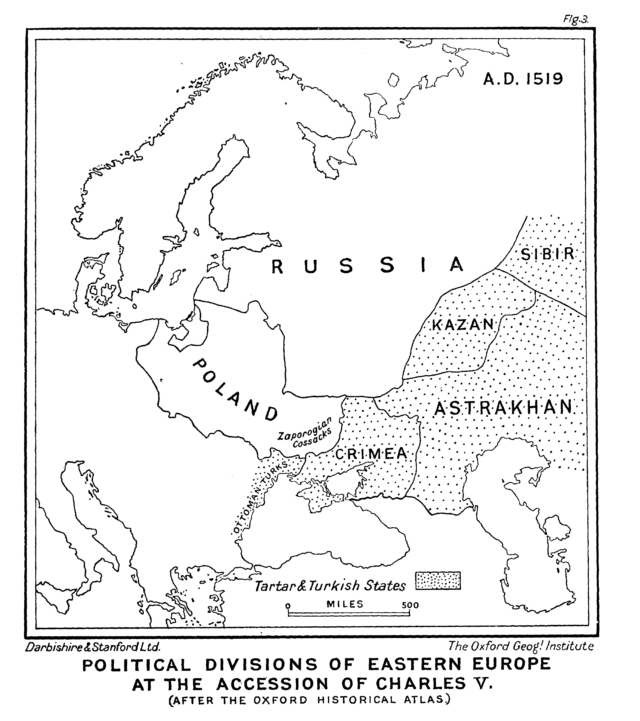
At first sight it would appear that in these familiar facts we have a correlation between natural environment and political organization so obvious as hardly to be worthy of description, especially when we note that throughout the Russian plain a cold winter is opposed to a hot summer, and the conditions of human existence thus rendered additionally uniform. Yet a series of historical maps, such as that contained in the Oxford Atlas, will reveal the fact that not merely is the rough coincidence of European Russia with the Eastern Plain of Europe a matter of the last hundred years or so, but that in all earlier time there was persistent re-assertion of quite another tendency in the political grouping. Two groups of states usually divided the country into northern and southern political systems. The fact is that the orographical map does not express the particular physical contrast which has until very lately controlled human movement and settlement in Russia. When the screen of winter snow fades northward off the vast face of the plain, it is followed by rains whose maximum occurs in May and June beside the Black sea, but near the Baltic and White seas is deferred to July and August. In the south the later summer is a period of drought. As a consequence of this climatic régime, the north and north-west were forest broken only by marshes, whereas the south and south-east were a boundless grassy steppe, with trees only along the rivers.
The line separating the two regions ran diagonally north-eastward from the northern end of the Carpathians to a point in the Ural range nearer to its southern than to its northern extremity. Moscow lies a little to north of this line, or, in other words, on the forest side of it. Outside Russia the boundary of the great forest ran westward almost exactly through the centre of the European isthmus, which is 800 miles across between the Baltic and the Black seas. Beyond this, in Peninsular Europe, the woods spread on through the plains of Germany in the north, while the steppe lands in the south turned the great Transylvanian bastion of the Carpathians, and extended up the Danube, through what are now the cornfields of Roumania, to the Iron Gates. A detached area of steppes, known locally as Pusstas, now largely cultivated, occupied the plain of Hungary, ingirt by the forested rim of Carpathian and Alpine mountains. In all the west of Russia, save in the far north, the clearing of the forests, the drainage of the marshes, and the tillage of the steppes have recently averaged the character of the landscape, and in large measure obliterated a distinction which was formerly very coercive of humanity.
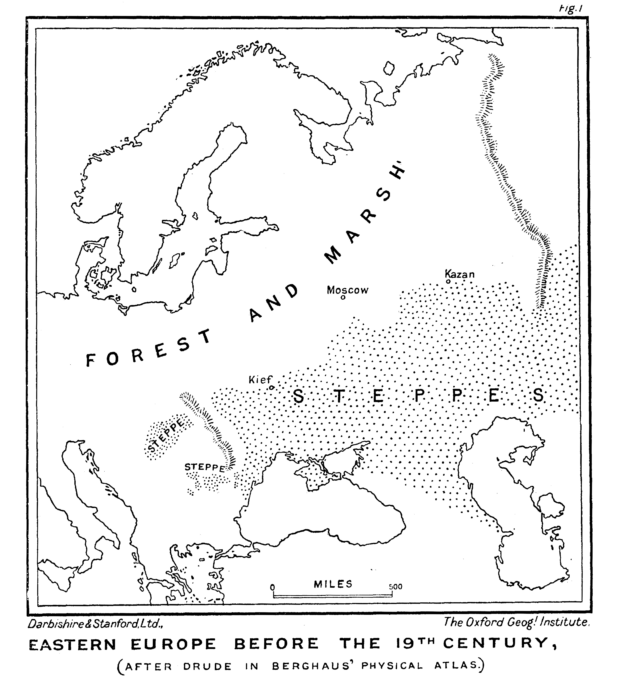
The earlier Russia and Poland were established wholly in the glades of the forest. Through the steppe on the other hand there came from the unknown recesses of Asia, by the gateway between the Ural mountains and the Caspian sea, in all the centuries from the fifth to the sixteenth, a remarkable succession of Turanian nomadic peoples — Huns, Avars, Bulgarians, Magyars, Khazars, Patzinaks, Cumans, Mongols, Kalmuks. Under Attila the Huns established themselves in the midst of the Pusstas, in the uttermost Danubian outlier of the steppes, and thence dealt blows northward, westward, and southward against the settled peoples of Europe. A large part of modern history might be written as a commentary upon the changes directly or indirectly ensuing from these raids.
The Angles and Saxons, it is quite possible, were then driven to cross the seas to found England in Britain. The Franks, the Goths, and the Roman provincials were compelled, for the first time, to stand shoulder to shoulder on the battlefield of Chalons, making common cause against the Asiatics, who were unconsciously welding together modern France. Venice was founded from the destruction of Aquileia and Padua; and even the Papacy owed a decisive prestige to the successful mediation of Pope Leo with Attila at Milan. Such was the harvest of results produced by a cloud of ruthless and idealess horsemen sweeping over the unimpeded plain — a blow, as it were, from the great Asiatic hammer striking freely through the vacant space. The Huns were followed by the Avars. It was for a marchland against these that Austria was founded, and Vienna fortified, as the result of the campaigns of Charlemagne.
The Magyar came next, and by incessant raiding from his steppe base in Hungary increased the significance of the Austrian outpost, so drawing the political focus of Germany eastward to the margin of the realm. The Bulgarian established a ruling caste south of the Danube, and has left his name upon the map, although his language has yielded to that of his Slavonic subjects. Perhaps the longest and most effective occupation of the Russian steppe proper was that of the Khazars, who were contemporaries of the great Saracen movement: the Arab geographers knew the Caspian as the Khazar sea. In the end, however, new hordes arrived from Mongolia, and for two centuries Russia in the northern forest was held tributary to the Mongol Khans of Kipchak, or “the Steppe,” and Russian development was thus delayed and biassed at a time when the remainder of Europe was rapidly advancing.
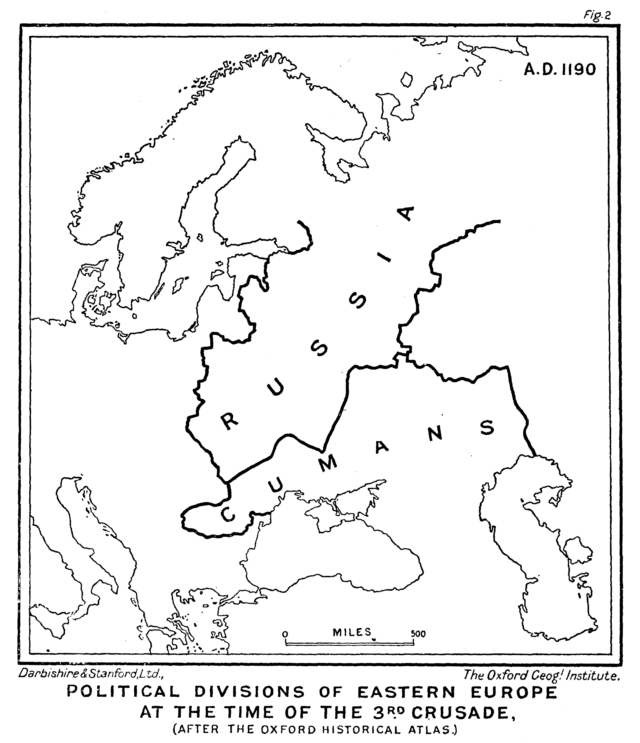
It should be noted that the rivers running from the Forest to the Black and Caspian seas cross the whole breadth of the steppe-land path of the nomads, and that from time to time there were transient movements along their courses at right angles to the movement of the horsemen. Thus the missionaries of Greek Christianity ascended the Dnieper to Kief, just as beforehand the Norse Varangians had descended the same river on their way to Constantinople. Still earlier, the Teutonic Goths appear for a moment upon the Dniester, having crossed Europe from the shores of the Baltic in the same south-eastward direction. But these are passing episodes which do not invalidate the broader generalization. For a thousand years a series of horse-riding peoples emerged from Asia through the broad interval between the Ural mountains and the Caspian sea, rode through the open spaces of southern Russia, and struck home into Hungary in the very heart of the European peninsula, shaping by the necessity of opposing them the history of each of the great peoples around — the Russians, the Germans, the French, the Italians, and the Byzantine Greeks. That they stimulated healthy and powerful reaction, instead of crushing opposition under a widespread despotism, was due to the fact that the mobility of their power was conditioned by the steppes, and necessarily ceased in the surrounding forests and mountains.
A rival mobility of power was that of the Vikings in their boats. Descending from Scandinavia both upon the northern and the southern shores of Europe, they penetrated inland by the river ways. But the scope of their action was limited, for, broadly speaking, their power was effective only in the neighbourhood of the water. Thus the settled peoples of Europe lay gripped between two pressures — that of the Asiatic nomads from the east, and on the other three sides that of the pirates from the sea. From its very nature neither pressure was overwhelming, and both therefore were stimulative. It is noteworthy that the formative influence of the Scandinavians was second only in significance to that of the nomads, for under their attack both England and France made long moves towards unity, while the unity of Italy was broken by them. In earlier times, Rome had mobilized the power of her settled peoples by means of her roads, but the Roman roads had fallen into decay, and were not replaced until the eighteenth century.
It is likely that even the Hunnish invasion was by no means the first of the Asiatic series. The Scythians of the Homeric and Herodotian accounts, drinking the milk of mares, obviously practised the same arts of life, and were probably of the same race as the later inhabitants of the steppe. The Celtic element in the river-names Don, Donetz, Dneiper, Dneister, and Danube may possibly betoken the passage of peoples of similar habits, though not of identical race, but it is not unlikely that the Celts came merely from the northern forests, like the Goths and Varangians of a later time. The great wedge of population, however, which the anthropologists characterize as Brachy-Cephalic, driven westward from Brachy-Cephalic Asia through Central Europe into France, is apparently intrusive between the northern, western, and southern Dolico-Cephalic populations, and may very probably have been derived from Asia.[1]
The Geography of Euro-Asia
The full meaning of Asiatic influence upon Europe is not, however, discernible until we come to the Mongol invasions of the fifteenth century; but before we analyze the essential facts concerning these, it is desirable to shift our geographical view-point from Europe, so that we may consider the Old World in its entirety. It is obvious that, since the rainfall is derived from the sea, the heart of the greatest land-mass is likely to be relatively dry. We are not, therefore, surprised to find that two-thirds of all the world’s population is concentrated in relatively small areas along the margins of the great continent — in Europe, beside the Atlantic ocean; in the Indies and China, beside the Indian and Pacific oceans. A vast belt of almost uninhabited, because practically rainless, land extends as the Sahara completely across Northern Africa into Arabia. Central and Southern Africa were almost as completely severed from Europe and Asia throughout the greater part of history as were the Americas and Australia.
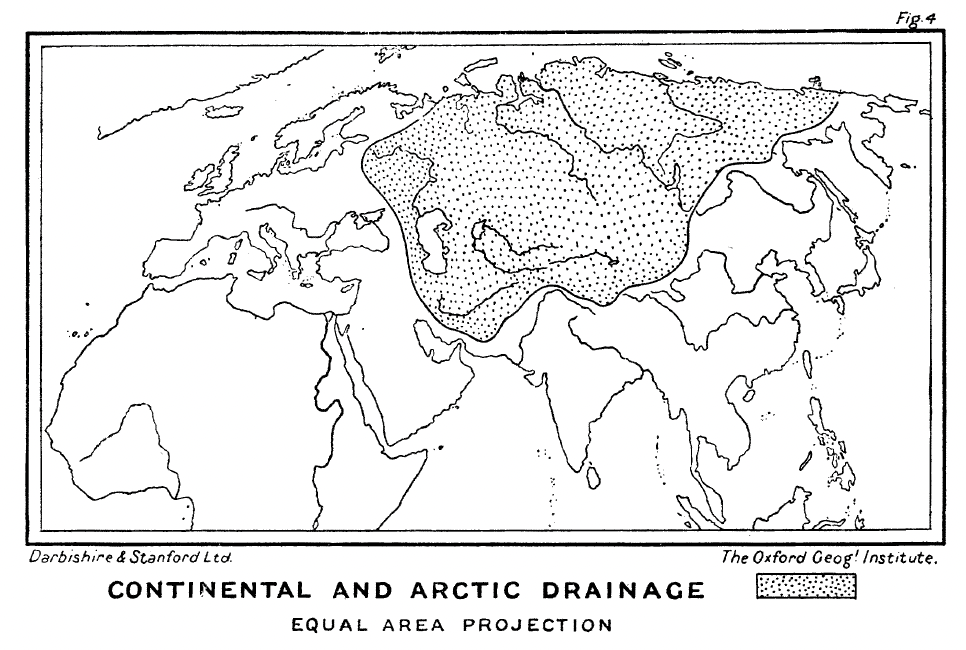
In fact, the southern boundary of Europe was and is the Sahara rather than the Mediterranean, for it is the desert which divides the black man from the white. The continuous land-mass of Euro-Asia thus included between the ocean and the desert measures 21,000,000 square miles, or half of all the land on the globe, if we exclude from reckoning the deserts of Sahara and Arabia. There are many detached deserts scattered through Asia, from Syria and Persia north-eastward to Manchuria, but no such continuous vacancy as to be comparable with the Sahara. On the other hand, Euro-Asia is characterized by a very remarkable distribution of river drainage. Throughout an immense portion of the centre and north, the rivers have been practically useless for purposes of human communication with the outer world. The Volga, the Oxus, and the Jaxartes drain into salt lakes; the Obi, the Yenesei, and the Lena into the frozen ocean of the north. These are six of the greatest rivers in the world. There are many smaller but still considerable streams in the same area, such as the Tarim and the Helmund, which similarly fail to reach the ocean. Thus the core of Euro-Asia, although mottled with desert patches, is on the whole a steppe-land supplying a wide-spread if often scanty pasture, and there are not a few river-fed oases in it, but it is wholly unpenetrated by waterways from the ocean.
In other words, we have in this immense area all the conditions for the maintenance of a sparse, but in the aggregate considerable, population of horse-riding and camel-riding nomads. Their realm is limited northward by a broad belt of sub-arctic forest and marsh, wherein the climate is too rigorous, except at the eastern and western extremities, for the development of agricultural settlements. In the east the forests extend southward to the Pacific coast in the Amur land and Manchuria. Similarly in the west, in prehistoric Europe, forest was the predominant vegetation. Thus framed in to the north-east, north, and north-west, the steppes spread continuously for 4000 miles from the Pusstas of Hungary to the Little Gobi of Manchuria, and, except in their westernmost extremity, they are untraversed by rivers draining to an accessible ocean, for we may neglect the very recent efforts to trade to the mouths of the Obi and Yenisei. In Europe, Western Siberia, and Western Turkestan the steppe lands lie low, in some places below the level of the sea. Further to east, in Mongolia, they extend over plateaux; but the passage from the one level to the other, over the naked, unscarped lower ranges of the arid heart-land, presents little difficulty.
The Mongol Expansion
The hordes which ultimately fell upon Europe in the middle of the fourteenth century gathered their first force 3000 miles away on the high steppes of Mongolia. The havoc wrought for a few years in Poland, Silesia, Moravia, Hungary, Croatia, and Servia was, however, but the remotest and the most transient result of the great stirring of the nomads of the East associated with the name of Ghenghiz Khan. While the Golden Horde occupied the steppe of Kipchak, from the Sea of Aral, through the interval between the Ural range and the Caspian, to the foot of the Carpathians, another horde, descending south-westward between the Caspian sea and the Hindu Kush into Persia, Mesopotamia, and even into Syria, founded the domain of the Ilkhan. A third subsequently struck into Northern China, conquering Cathay. India and Mangi, or Southern China, were for a time sheltered by the incomparable barrier of Tibet, to whose efficacy there is, perhaps, nothing similar in the world, unless it be the Sahara desert and the polar ice. But at a later time, in the days of Marco Polo in the case of Mangi, in those of Tamerlane in the case of India, the obstacle was circumvented. Thus it happened that in this typical and well-recorded instance, all the settled margins of the Old World sooner or later felt the expansive force of mobile power originating in the steppe. Russia, Persia, India, and China were either made tributary, or received Mongol dynasties. Even the incipient power of the Turks in Asia Minor was struck down for half a century.
As in the case of Europe, so in other marginal lands of Euro-Asia there are records of earlier invasions. China had more than once to submit to conquest from the north; India several times to conquest from the north-west. In the case of Persia, however, at least one of the earlier descents has a special significance in the history of Western civilization. Three or four centuries before the Mongols, the Seljuk Turks, emerging from Central Asia, overran by this path an immense area of the land, which we may describe as of the five seas — Caspian, Black, Mediterranean, Red, and Persian. They established themselves at Kerman, at Hamadan, and in Asia Minor, and they overthrew the Saracen dominion of Bagdad and Damascus. It was ostensibly to punish their treatment of the Christian pilgrims at Jerusalem that Christendom undertook the great series of campaigns known collectively as the Crusades. Although these failed in their immediate objects, they so stirred and united Europe that we may count them as the beginning of modern history — another striking instance of European advance stimulated by the necessity of reacting against pressure from the heart of Asia.
The conception of Euro-Asia to which we thus attain is that of a continuous land, ice-girt in the north, water-girt elsewhere, measuring 21 million square miles, or more than three times the area of North America, whose centre and north, measuring some 9 million square miles, or more than twice the area of Europe, have no available water-ways to the ocean, but, on the other hand, except in the subarctic forest, are very generally favourable to the mobility of horsemen and camelmen. To east, south, and west of this heart-land are marginal regions, ranged in a vast crescent, accessible to shipmen.
Sea-Power and the Cape Route
The all-important result of the discovery of the Cape road to the Indies was to connect the western and eastern coastal navigations of Euro-Asia, even though by a circuitous route, and thus in some measure to neutralize the strategical advantage of the central position of the steppe-nomads by pressing upon them in rear. The revolution commenced by the great mariners of the Columbian generation endowed Christendom with the widest possible mobility of power, short of a winged mobility. The one and continuous ocean enveloping the divided and insular lands is, of course, the geographical condition of ultimate unity in the command of the sea, and of the whole theory of modern naval strategy and policy as expounded by such writers as Captain Mahan and Mr. Spencer Wilkinson. The broad political effect was to reverse the relations of Europe and Asia, for whereas in the Middle Ages Europe was caged between an impassable desert to south, an unknown ocean to west, and icy or forested wastes to north and north-east, and in the east and south-east was constantly threatened by the superior mobility of the horsemen and camelmen, she now emerged upon the world, multiplying more than thirty-fold the sea surface and coastal lands to which she had access, and wrapping her influence round the Euro-Asiatic land-power which had hitherto threatened her very existence. New Europes were created in the vacant lands discovered in the midst of the waters, and what Britain and Scandinavia were to Europe in the earlier time, that have America and Australia, and in some measure even Trans-Saharan Africa, now become to Euro-Asia. Britain, Canada, the United States, South Africa, Australia, and Japan are now a ring of outer and insular bases for sea-power and commerce, inaccessible to the land-power of Euro-Asia.
But the land power still remains, and recent events have again increased its significance. While the maritime peoples of Western Europe have covered the ocean with their fleets, settled the outer continents, and in varying degree made tributary the oceanic margins of Asia, Russia has organized the Cossacks, and, emerging from her northern forests, has policed the steppe by setting her own nomads to meet the Tartar nomads. The Tudor century, which saw the expansion of Western Europe over the sea, also saw Russian power carried from Moscow through Siberia. The eastward swoop of the horsemen across Asia was an event almost as pregnant with political consequences as was the rounding of the Cape, although the two movements long remained apart.
The Railway Age
A generation ago steam and the Suez canal appeared to have increased the mobility of sea-power relatively to land-power. Railways acted chiefly as feeders to ocean-going commerce. But trans-continental railways are now transmuting the conditions of land-power, and nowhere can they have such effect as in the closed heart-land of Euro-Asia, in vast areas of which neither timber nor accessible stone was available for road-making. Railways work the greater wonders in the steppe, because they directly replace horse and camel mobility, the road stage of development having here been omitted.
In the matter of commerce it must not be forgotten that ocean-going traffic, however relatively cheap, usually involves the fourfold handling of goods — at the factory of origin, at the export wharf, at the import wharf, and at the inland warehouse for retail distribution; whereas the continental railway truck may run direct from the exporting factory into the importing warehouse. Thus marginal ocean-fed commerce tends, other things being equal, to form a zone of penetration round the continents, whose inner limit is roughly marked by the line along which the cost of four handlings, the oceanic freight, and the railway freight from the neighbouring coast, is equivalent to the cost of two handlings and the continental railway freight. English and German coals are said to compete on such terms midway through Lombardy.
The Russian railways have a clear run of 6000 miles from Wirballen in the west to Vladivostok in the east. The Russian army in Manchuria is as significant evidence of mobile land-power as the British army in South Africa was of sea-power. True, that the Trans-Siberian railway is still a single and precarious line of communication, but the century will not be old before all Asia is covered with railways. The spaces within the Russian Empire and Mongolia are so vast, and their potentialities in population, wheat, cotton, fuel, and metals so incalculably great, that it is inevitable that a vast economic world, more or less apart, will there develop inaccessible to oceanic commerce.
The Pivot Region
As we consider this rapid review of the broader currents of history, does not a certain persistence of geographical relationship become evident? Is not the pivot region of the world’s politics that vast area of Euro-Asia which is inaccessible to ships, but in antiquity lay open to the horse-riding nomads, and is to-day about to be covered with a network of railways? There have been and are here the conditions of a mobility of military and economic power of a far-reaching and yet limited character. Russia replaces the Mongol Empire. Her pressure on Finland, on Scandinavia, on Poland, on Turkey, on Persia, on India, and on China, replaces the centrifugal raids of the steppemen. In the world at large she occupies the central strategical position held by Germany in Europe. She can strike on all sides and be struck from all sides, save the north. The full development of her modern railway mobility is merely a matter of time. Nor is it likely that any possible social revolution will alter her essential relations to the great geographical limits of her existence. Wisely recognizing the fundamental limits of her power, her rulers have parted with Alaska; for it is as much a law of policy for Russia to own nothing over seas as for Britain to be supreme on the ocean.
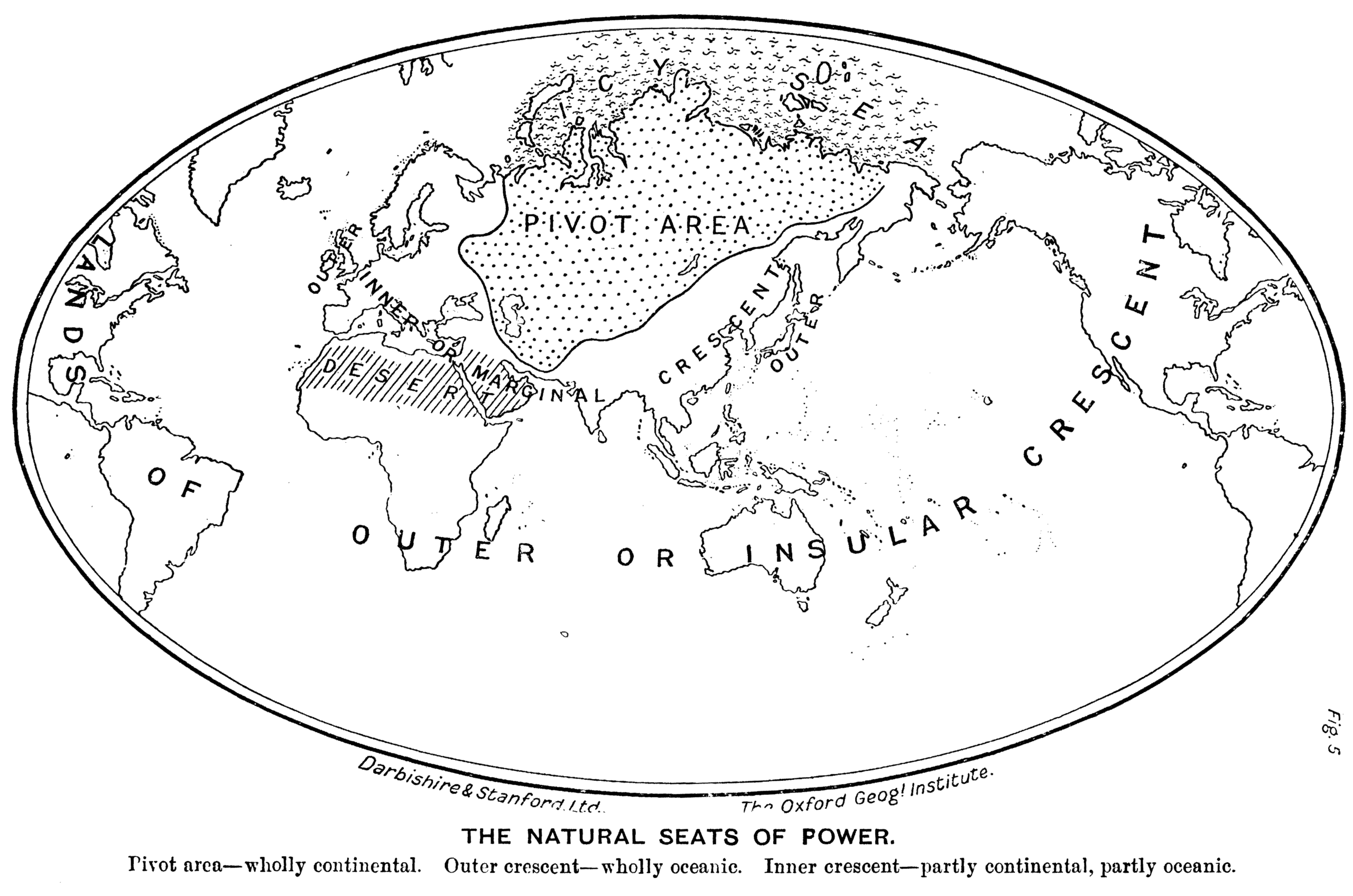
Outside the pivot area, in a great inner crescent, are Germany, Austria, Turkey, India, and China, and in an outer crescent, Britain, South Africa, Australia, the United States, Canada, and Japan. In the present condition of the balance of power, the pivot state, Russia, is not equivalent to the peripheral states, and there is room for an equipoise in France. The United States has recently become an eastern power, affecting the European balance not directly, but through Russia, and she will construct the Panama canal to make her Mississippi and Atlantic resources available in the Pacific. From this point of view the real divide between east and west is to be found in the Atlantic ocean.
Strategic Implications
The oversetting of the balance of power in favour of the pivot state, resulting in its expansion over the marginal lands of Euro-Asia, would permit of the use of vast continental resources for fleet-building, and the empire of the world would then be in sight. This might happen if Germany were to ally herself with Russia. The threat of such an event should, therefore, throw France into alliance with the over-sea powers, and France, Italy, Egypt, India, and Corea would become so many bridge heads where the outside navies would support armies to compel the pivot allies to deploy land forces and prevent them from concentrating their whole strength on fleets. On a smaller scale that was what Wellington accomplished from his sea-base at Torres Vedras in the Peninsular War. May not this in the end prove to be the strategical function of India in the British Imperial system?
The development of the vast potentialities of South America might have a decisive influence upon the system. They might strengthen the United States, or, on the other hand, if Germany were to challenge the Monroe doctrine successfully, they might detach Berlin from what I may perhaps describe as a pivot policy. The particular combinations of power brought into balance are not material; my contention is that from a geographical point of view they are likely to rotate round the pivot state, which is always likely to be great, but with limited mobility as compared with the surrounding marginal and insular powers.
I have spoken as a geographer. The actual balance of political power at any given time is, of course, the product, on the one hand, of geographical conditions, both economic and strategic, and, on the other hand, of the relative number, virility, equipment, and organization of the competing peoples. In proportion as these quantities are accurately estimated are we likely to adjust differences without the crude resort to arms. And the geographical quantities in the calculation are more measurable and more nearly constant than the human. Hence we should expect to find our formula apply equally to past history and to present politics. The social movements of all times have played around essentially the same physical features, for I doubt whether the progressive desiccation of Asia and Africa, even if proved, has in historical times vitally altered the human environment. The westward march of empire appears to me to have been a short rotation of marginal power round the south-western and western edge of the pivotal area. The Nearer, Middle, and Far Eastern questions relate to the unstable equilibrium of inner and outer powers in those parts of the marginal crescent where local power is, at present, more or less negligible.
In conclusion, it may be well expressly to point out that the substitution of some new control of the inland area for that of Russia would not tend to reduce the geographical significance of the pivot position. Were the Chinese, for instance, organized by the Japanese, to overthrow the Russian Empire and conquer its territory, they might constitute the yellow peril to the world’s freedom just because they would add an oceanic frontage to the resources of the great continent, an advantage as yet denied to the Russian tenant of the pivot region.
Notes
[1] See The Races of Europe, by Prof. W. Z. Ripley (Kegan Paul, 1900). ↩
[2] This statement was criticized in the discussion which followed the reading of the paper. On reconsidering the paragraph, I still think it substantially correct. Even the Byzantine Greek would have been other than he was had Rome completed the subjugation of the ancient Greek. No doubt the ideals spoken of were Byzantine rather than Hellenic, but they were not Roman, which is the point. ↩

