
Hormuz Island
Intro
Situated directly at the entrance of the Persian Gulf, Hormuz Island occupies a commanding position over shipping lanes connecting global energy markets with Gulf producers. Its geography gives it relevance far beyond its size or population.
Background
Historically contested due to its position, the island has long been used to project control over maritime traffic. In modern Iranian doctrine, it forms part of a layered coastal and island-based deterrence system in the Strait of Hormuz.
History
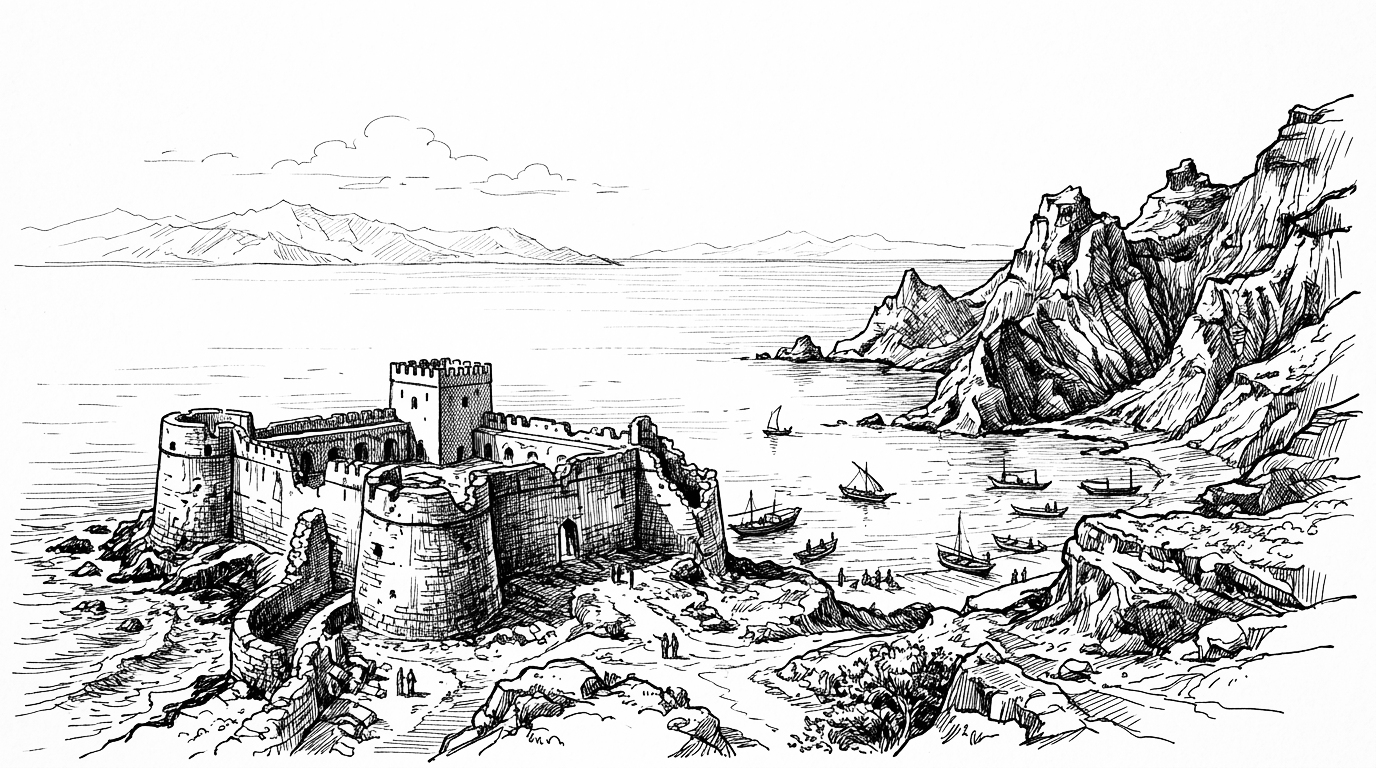
Hormuz Island dominated the entrance to the Persian Gulf for centuries and was seized by the Portuguese in 1507 as a strategic base for their Indian Ocean empire. The island became one of the most valuable trading posts in Asia, with merchants from across the Indian Ocean world paying customs to the Portuguese garrison. Shah Abbas I, with English East India Company naval assistance, expelled the Portuguese in 1622 and transferred Gulf trade to the mainland port that became Bandar Abbas.
After this strategic reorientation the island lost commercial significance but retained geographic importance. After 1979 it was integrated into the layered asymmetric maritime defence system Iran has developed to threaten shipping access to the Gulf.
Present Day
Today Hormuz Island hosts military installations, surveillance infrastructure, and limited civilian settlement. It is a key element in Iran’s ability to threaten, monitor, or control transit through the Strait of Hormuz in crisis scenarios.
Future Outlook
Map
Articles

Return to Babel: Language, Identity, and Belonging
How identity is filtered — not by law, but by design – and what it means to belong

Russia’s War Machine: How It Fights Without Winning
As negotiations flicker in the background of a grinding war, Russia’s ability to sustain its military effort in Ukraine depends on a fragile web of foreign supply, internal mobilization, and retrofitted Soviet stockpiles. This report examines the current state of Russia’s armed forces in Q2 2025, revealing a system stretched but still operational — and why that matters.


Don’t Bet on the Bully: Why Europe Must Stop Investing in the U.S.
As European firms like Daimler, Volkswagen, and Siemens expand their investments in the U.S., they risk tying their futures to a volatile partner. Short-term economic incentives and a temporarily favorable exchange rate obscure deeper structural risks: political instability, panic-driven corporate culture, and growing protectionism. Europe is not dependent on the U.S. — not for gas, not for markets, and certainly not for leadership. Strategic autonomy begins with saying no.

How Donald Trump Could Win the Nobel Prize for Peace
Donald Trump, the dealmaker, the disrupter — could he still become a man of peace? What would it take? Humility!


After the War: The Eurasian Covenant
“After the War: The Eurasian Covenant” is not a deal, nor a surrender — but a framework. A vision for lasting peace between Europe, Ukraine, and Russia rooted in dignity, realism, and historical awareness. As old alliances shift and global power balances evolve, this proposal outlines a European-led path forward: balancing security, rebuilding trust, and preparing for a post-hegemonic world. A beginning — before it’s too late.
Event Timeline

Pereyaslav Agreement with Tsarist Russia
The Pereyaslav Agreement between the Cossack Hetmanate and Tsarist Russia marked the beginning of Ukraine’s alignment with Russia, which would evolve into centuries of political, military, and cultural influence.

Union of Lublin – Polish Lithuanian Commonwealth
Before Moscow, there was Lublin. The Polish–Lithuanian Commonwealth laid the groundwork for Western Ukrainian identity — and for centuries of contested rule.

Eurasian Peace Talks
A Summer-offensive is at hand – though strategic talks are still possible.

Crimea Annexation by Russia
In the shadow of Ukraine’s Maidan uprising, Russian forces seized control of Crimea. What followed was a swift, illegal annexation — a violation of international norms that shattered post–Cold War assumptions and launched a new era of geopolitical confrontation.

The Hanseatic League
Beginning in the 14th century, a group of northern European cities formed a commercial and legal alliance that would dominate Baltic trade for centuries. Known as the Hanseatic League, this urban confederation connected ports from Flanders to Novgorod, enabling secure trade, mutual defense, and legal cooperation without central rule.

Holodomor Famine
The Holodomor Famine was a man-made catastrophe under Stalin’s regime that devastated Ukraine, killing millions of Ukrainians and leaving a permanent scar on the national consciousness.

Ukraine’s Declaration of Independence
After decades as a Soviet republic, Ukraine asserted its sovereignty on 24 August 1991. This act of independence emerged from the ashes of empire — a democratic rebirth with fragile roots and far-reaching consequences.

Attack on Sumy, at Palm Sunday, 2025
On Palm Sunday, April 13th, 2025, Russian forces struck the Ukrainian city of Sumy, killing civilians and sending a symbolic message of hatred. The attack violated not just laws of war, but shared cultural and spiritual bonds. It stands as one of the most morally grotesque moments of the ongoing invasion.

Kievan Rus
The Founding of Kievan Rus marks the establishment of the first East Slavic state centered around Kyiv, which laid the foundations for modern Ukraine, Belarus, and Russia.


The Sumy Attack: Beyond Violence, Towards Understanding the Message
On Palm Sunday, Russia attacked the Ukrainian city of Sumy in an act that went beyond war — a message of hatred that struck civilians and sacred meaning alike.