
1955-05-14
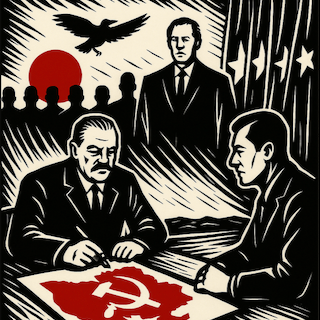
In May 1955, the Soviet Union and seven Eastern European states signed a mutual defense treaty in Warsaw, creating the Warsaw Pact.
Background
Following NATO’s formation in 1949 and West Germany’s integration in 1955, Moscow responded with a counter-alliance. The Warsaw Treaty of Friendship, Cooperation, and Mutual Assistance established a military and political alliance under de facto Soviet command. Though framed as voluntary, the Pact functioned as an enforcement mechanism of Soviet control, coordinating foreign policy and military planning—often at the expense of national sovereignty. It later enabled interventions in Hungary (1956) and Czechoslovakia (1968), reinforcing Cold War tensions.
Legacy
Institutionalized the East–West divide in Europe Enabled Soviet interventions in satellite states Dissolved in 1991 following democratic transitions
Key Moment
Perspective & Relations
Narratives
| Institutionalized the East–West divide in Europe Enabled Soviet interventions in satellite states Dissolved in 1991 following democratic transitions | ||
| In May 1955, the Soviet Union and seven Eastern European states signed a mutual defense treaty in Warsaw, creating the Warsaw Pact. It solidified the division of Europe and institutionalized the Soviet bloc in direct opposition to NATO. | ||
| Following NATO’s formation in 1949 and West Germany’s integration in 1955, Moscow responded with a counter-alliance. The Warsaw Treaty of Friendship, Cooperation, and Mutual Assistance established a military and political alliance under de facto Soviet command. Though framed as voluntary, the Pact functioned as an enforcement mechanism of Soviet control, coordinating foreign policy and military planning—often at the expense of national sovereignty. It later enabled interventions in Hungary (1956) and Czechoslovakia (1968), reinforcing Cold War tensions. | ||
| May 14, 1955 – The signing ceremony in Warsaw codified the Eastern Bloc’s shared military posture against Western alliances. | ||
| In May 1955, the Soviet Union and seven Eastern European states signed a mutual defense treaty in Warsaw, creating the Warsaw Pact. It solidified the division of Europe and institutionalized the Soviet bloc in direct opposition to NATO. | ||
| Following NATO’s formation in 1949 and West Germany’s integration in 1955, Moscow responded with a counter-alliance. The Warsaw Treaty of Friendship, Cooperation, and Mutual Assistance established a military and political alliance under de facto Soviet command. Though framed as voluntary, the Pact functioned as an enforcement mechanism of Soviet control, coordinating foreign policy and military planning—often at the expense of national sovereignty. It later enabled interventions in Hungary (1956) and Czechoslovakia (1968), reinforcing Cold War tensions. | ||
| May 14, 1955 – The signing ceremony in Warsaw codified the Eastern Bloc’s shared military posture against Western alliances. | ||
| Institutionalized the East–West divide in Europe Enabled Soviet interventions in satellite states Dissolved in 1991 following democratic transitions | ||
| Array | ||
| Array |