
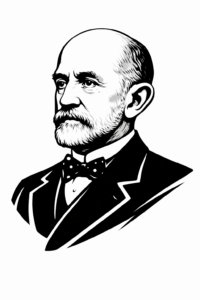
- 1840-09-27 — Born
Born in West Point, New York, into a military family. - 1856 — Naval Academy
Enters the United States Naval Academy at Annapolis. - 1890 — Major Work Published
Publishes *The Influence of Sea Power upon History, 1660-1783*. - 1896 — Naval War College
Serves as president of the U.S. Naval War College. - 1914-12-01 — Death
Dies in Washington, D.C., shortly after the outbreak of World War I.
Alfred Thayer Mahan framed maritime power as the backbone of global influence. Writing at the moment industrial states expanded overseas, he argued that command of the seas determined trade security, imperial reach, and wartime success.
His theory rested on concentration: decisive fleets, strategic chokepoints, and permanent naval bases. Commerce and navy were inseparable. States that failed to protect sea lanes would decline regardless of land strength.
Mahan’s work was historical rather than abstract. He drew lessons from Britain’s rise, emphasizing continuity between economic vitality and naval dominance. He rejected dispersion, improvisation, and purely defensive naval postures.
Although American in origin, Mahan’s influence was global. Germany, Japan, and Britain all incorporated his ideas-sometimes more rigorously than the United States itself. His theories fed arms races, imperial planning, and pre-1914 strategic anxieties.
Critics later faulted Mahan for underestimating submarines, air power, and economic interdependence. Yet his core insight-that geography, trade, and military power intersect at sea-remains structurally valid.