
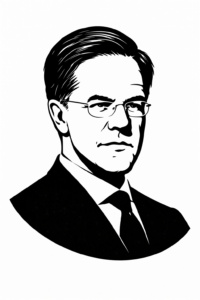
- 1967-02-14 — Born
Born in The Hague, Netherlands. - 2006-05 — Party Leadership
Becomes leader of the VVD, positioning the party toward pragmatic liberal conservatism. - 2010-10-14 — Prime Minister
Appointed Prime Minister of the Netherlands, leading a minority coalition. - 2012-09 — Re-election
Wins re-election amid European debt crisis, consolidating reputation as crisis manager. - 2017-03 — Coalition Survival
Forms a four-party coalition after prolonged negotiations, reinforcing image of political endurance. - 2021-01 — Cabinet Resignation and Return
Government resigns over childcare benefits scandal; Rutte returns after elections, underscoring electoral resilience. - 2024-10-01 — NATO Secretary General
Assumes office as Secretary General of NATO, succeeding Jens Stoltenberg.
Mark Rutte’s political identity is defined less by ideology than by operational skill. Trained as a manager rather than a theorist, he developed a leadership style centered on recall, timing, and verbal control. His reputation for remembering conversations, positions, and commitments earned him the informal characterization as a “master of memorization” within European politics.
As Prime Minister, Rutte navigated an unusually fragmented political landscape. Dutch governance under his tenure relied on shifting coalitions, incremental compromise, and rhetorical flexibility. Rather than imposing a grand vision, Rutte focused on maintaining governability, often absorbing criticism to preserve institutional continuity.
Rutte’s approach to power was defensive and adaptive. He avoided doctrinal confrontation, preferring ambiguity where clarity would fracture alliances. This enabled longevity but also produced criticism that his leadership lacked moral or strategic depth, particularly during domestic scandals and debates over migration, social trust, and administrative accountability.
Internationally, Rutte aligned consistently with Atlantic partners. He supported NATO expansion, sustained backing for Ukraine after 2022, and close coordination with U.S. administrations across party lines. His credibility rested on reliability rather than inspiration.
His transition to NATO Secretary General reflects this profile. Rutte is positioned as a managerial stabilizer rather than a visionary reformer, tasked with maintaining alliance cohesion under conditions of military escalation, political divergence among members, and long-term confrontation with Russia.
Rutte’s legacy is therefore procedural rather than transformational. He exemplifies late-modern executive leadership: durable, adaptive, rhetorically agile, and institutionally loyal-effective at keeping systems running, less concerned with redefining their purpose.