
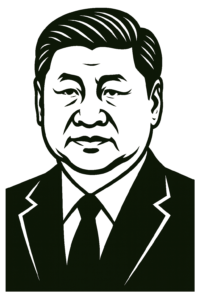
- 1953-06-15 — Born
Born in Beijing as the son of revolutionary veteran Xi Zhongxun. - 1974 — Joined Organization
Joined the Chinese Communist Party (CCP) in Hebei Province. - 1999 — Governor
Appointed Governor of Fujian Province, serving until 2002. - 2002 — Party Secretary
Served as Secretary of the Zhejiang Provincial CCP Committee, serving until 2007. - 2007 — Party Secretary
Appointed Secretary of the Shanghai Municipal CCP Committee. - 2007 — Politburo Standing Committee
Became a member of the Politburo Standing Committee of the CCP and served as President of the Central Party School. - 2008 — Vice-President
Held the position of Vice-President of the People's Republic of China, serving until 2013. - 2010 — Vice-Chairman
Served as Vice-Chairman of the Central Military Commission until 2012. - 2012 — General Secretary
Assumed the roles of General Secretary of the CCP Central Committee and Chairman of the Central Military Commission. - 2013 — Elected President
Elected President of the People's Republic of China.
experienced both privilege and persecution during the Cultural Revolution. After years of provincial administration in Fujian, Zhejiang, and Shanghai, he rose to national prominence in 2012, succeeding Hu Jintao as Party General Secretary. His rule is defined by an extensive anti-corruption campaign, the abolition of term limits, and consolidation of command through Party-led commissions. Under Xi, ideology “Xi Jinping Thought” was written into the constitution, while digital and security apparatuses expanded under the ideal of a “modern socialist state.” Economically, Xi promotes “dual circulation” and self-reliance in technology, while emphasizing political loyalty over market liberalization. Internationally, he has steered China toward global assertiveness – Belt and Road expansion, rivalry with the United States, and strengthened ties with Russia and the Global South. pandemic lockdowns, slowing growth, and rising youth unemployment. Within the Party, recent purges and reshuffles reveal both control and fragility. As of 2025, speculation grows about succession scenarios and a possible transition to a post-Xi era, discussed under the concept of “Horizonism” (天际主义). ‘