

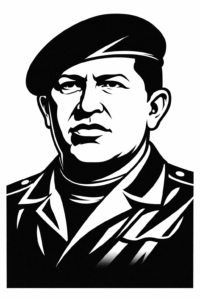
Venezuelan president and founder of the Bolivarian regime; charismatic leader who reshaped the state through ideology, redistribution, and personal authority.
Founded the Bolivarian political system, transformed Venezuelan institutions, expanded social programs, and created the conditions that enabled long-term authoritarian consolidation under his successors.
- 1954-07-28 — Born
Born in Sabaneta, Barinas, Venezuela, into a poor rural family. - 1992-02 — Failed Coup Attempt
Leads an unsuccessful military coup against President Carlos Andrés Pérez; becomes nationally known. - 1998-12-06 — Elected President
Wins presidential election on anti-elite, nationalist platform. - 1999 — New Constitution
Pushes through a new constitution redefining the Venezuelan state. - 2002-04 — Coup and Return
Briefly removed from office; returns to power within days with military and popular support. - 2006-12 — Re-elected
Consolidates power with a strong electoral mandate. - 2012-10 — Names Successor
Re-elected and publicly designates Nicolás Maduro as successor. - 2013-03-05 — Death
Dies of cancer, triggering succession and legitimacy crisis.
Hugo Chávez emerged from a society marked by inequality, corruption, and elite exhaustion. His formative years combined military discipline, nationalist myth, and resentment toward Venezuela’s political class. Chávez was neither a technocrat nor an ideologue in the classical sense; he was a storyteller, a mobilizer, and a performer who fused politics with identity.
His failed coup in 1992 was decisive. Though militarily unsuccessful, it transformed him into a symbol of defiance. Chávez learned that legitimacy in Venezuela could be forged outside institutions, through narrative and presence. When he entered electoral politics, he did not aim to reform the system but to replace it.
Once in power, Chávez governed through charisma rather than bureaucracy. Institutions were subordinated to personal authority. Elections remained, but the rules shifted. Redistribution programs created loyalty, while constitutional changes concentrated power. Opposition was tolerated unevenly, increasingly framed as betrayal rather than dissent.
Chávez’s worldview combined nationalism, anti-imperialism, and a moralized vision of politics. He cast Venezuela as a victim of global exploitation and himself as its redeemer. The United States functioned as a necessary antagonist, while alliances with Cuba, Russia, and later China reinforced a narrative of sovereignty and resistance.
Unlike later authoritarian leaders, Chávez retained genuine popular support for much of his rule. His legitimacy was emotional rather than procedural. Yet this same personalization hollowed out institutions. The economy became dependent on oil rents, governance on loyalty, and succession on designation rather than structure.
By naming Nicolás Maduro as successor, Chávez attempted to convert charisma into continuity. That conversion failed. What Chávez built through myth and presence could not be sustained through coercion alone. His death exposed the fragility of the system he created.
Chávez’s legacy is therefore dual. He gave voice and material relief to millions long excluded from power. He also dismantled institutional constraints and normalized rule by narrative. The Bolivarian system survived him-but only by abandoning the qualities that once made it viable.