
Situation
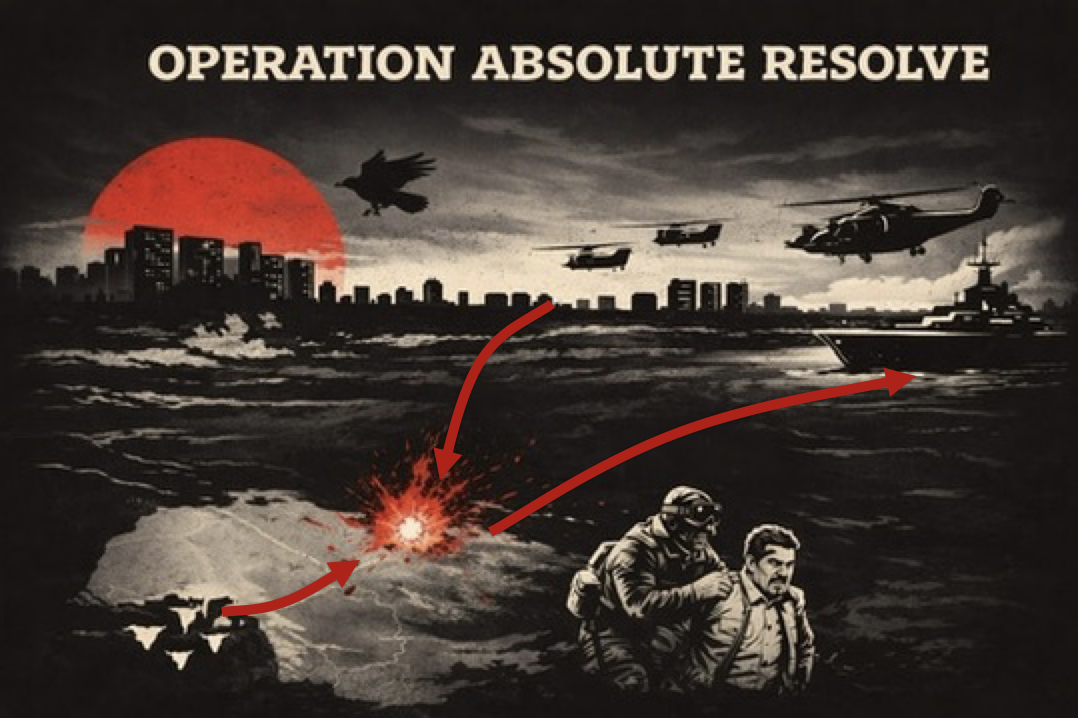
The United States of America attacked Venezuela and arrested Nicolás Maduro during the Operation Asbsolute Resolve.
- Nicolás Maduro has been removed from power through external intervention.
- The intervention was not authorised under international law.
- The removal of the regime is welcomed by large parts of the Venezuelan population and by several external actors (overheden).
These three facts describe the situation. No single one overrides the others.
The Regime
The Maduro regime no longer functioned as a normal state authority. Governance had been replaced by control.
Under Hugo Chávez, political loyalty became the primary criterion for institutional survival. Independent courts, media, and economic actors were progressively neutralised. Under Maduro, this system hardened. Coercive instruments replaced political consent. Opposition activity was criminalised. Elections lost credibility. The economy deteriorated beyond cyclical crisis.
As state capacity declined, repression increased. Public services collapsed. Inflation and shortages became structural. Emigration shifted from economic migration to mass displacement. The regime retained power, but no longer governed in a conventional sense.
This context explains why the removal of the regime does not face broad internal resistance. It also explains why external actors assess the outcome differently from the method.
Legal Position
The intervention violated international law.
There was no mandate from the United Nations, no collective authorisation, and no recognised legal basis for unilateral use of force under existing international frameworks. Claims related to drugs, regional security, or instability do not alter that assessment.
From the United States’ own perspective, the action is framed differently. Washington relies on executive authority under Article II of the U.S. Constitution, which grants the president broad powers in matters of foreign policy and national security. This provides a domestic legal basis for action, not an international one.
The intervention is also situated within a longer strategic tradition often associated with the Monroe Doctrine. That doctrine asserts a U.S. security interest in the Western Hemisphere. It has never constituted international law. It functions as a strategic claim, not a legal rule.
This distinction matters. Domestic authority and historical doctrine explain how the action was taken. They do not convert it into a lawful act under international law. The legal position of the intervention is therefore clear, even if its strategic rationale is not disputed.
Unilateral Approach
Taken together, this places the intervention squarely within how Donald Trump has positioned American power. Domestic authority is treated as sufficient. International constraint is treated as optional. Strategic doctrine substitutes for multilateral consent.
The logic is explicit: the United States can act because it is the United States. Legal criticism is acknowledged, but not accepted as limiting. This posture does not resolve the legal question. It explains the method.
Multilateral pathways were available in theory, but not in practice. Any attempt to seek collective authorisation would have introduced delay, uncertainty, and veto power. The outcome would likely have been preservation of the status quo rather than its removal.
This does not justify the action. It explains why it was executed this way.
Justifications and Real Drivers
Public justifications focused on drugs, security, and regional stability. These arguments are not fabricated, but they are incomplete.
Drug trafficking is a real problem. Fentanyl and cocaine cause measurable harm. States have a legitimate interest in countering transnational criminal networks. At the same time, Venezuela is not the primary source of most drugs entering the United States. Mexico and Colombia matter far more.
What distinguishes Venezuela is not volume, but vulnerability. The regime was isolated, economically weakened, and militarily exposed. The escalation risk was limited. The strategic value was high: oil, regional positioning, and influence over a key node in the Caribbean basin.
The driver is therefore not enforcement alone, but leverage.
Global Power, Precedent, and the Wider Game
This intervention sits within the global power game.
For the United States, Venezuela was a permissive case: limited resistance, manageable fallout, and clear strategic upside. Acting there does not challenge the system; it uses it as it currently stands.
The closest precedent is Panama in 1989. A regime was removed unilaterally in the Western Hemisphere. Legal objections followed. The outcome remained. The system adjusted. That precedent was never reversed; it was absorbed.
For Vladimir Putin and Xi Jinping, this outcome is unwelcome. Venezuela represented presence and leverage close to the United States. That leverage is now reduced. A direct response in the same theatre is not available without escalation. Strategic responses will be sought elsewhere.
This is where comparisons with Ukraine enter the discussion. Not as equivalence, but as illustration. Different cases, different contexts, same underlying dynamic: when major powers act outside formal constraints and succeed, expectations shift. What is possible in one theatre informs calculations in another.
And this is part of the Geopolitical Game of Global Power.
Responsibility After Intervention
The intervention changed Venezuela’s internal balance. That change has effects beyond the removal of Maduro.
Once a regime is removed externally, responsibility does not disappear at the moment of success. It shifts. The removal alters security conditions, power relations, and control over territory and resources. Those effects persist regardless of intent.
This does not imply long-term occupation or political management. It implies limited but concrete responsibilities. Preventing a security vacuum. Preventing fragmentation. Preventing large-scale retaliation or criminal takeover. These are baseline conditions, not policy ambitions.
If the United States disengages immediately after regime removal, the likely result is instability. That instability would not be accidental. It would follow directly from the altered balance created by the intervention.
Economic extraction without stabilisation would reinforce that outcome. It would concentrate gains while externalising risk. The burden would fall on the Venezuelan population and neighbouring states.
After Maduro
What follows now matters more than how the action is justified. The United States has altered the situation in Venezuela. That alteration carries responsibility toward the Venezuelan population.
The question at hand is how the consequences will be managed – or left behind. Will there be a better future for the Venezuelan people – rebuilding the nation? Or it becomes another case where regime removal is paid for by the people who were meant to benefit.
