
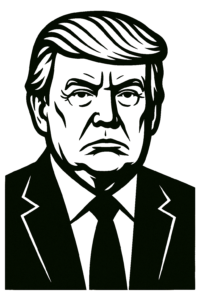
- 1946-06-14 — Born
Born in New York City into a real-estate dynasty. - 1971 — Took Over Family Business
Took control of his father's real estate company, later renamed The Trump Organization. - 2004 — The Apprentice
Launched "The Apprentice" reality TV show, becoming a household name and building his brand as a successful businessman. - 2015-06-16 — Presidential Campaign
Announced his candidacy for President of the United States, positioning himself as an anti-establishment outsider. - 2016-11-08 — Elected President
Won the 2016 presidential election, defeating Hillary Clinton in a surprising victory that reshaped American politics. - 2017-01-20 — Inauguration
Inaugurated as the 45th President of the United States. - 2020-11-03 — Lost Re-election
Lost the 2020 presidential election to Joe Biden, but refused to concede, claiming electoral fraud. - 2021-01-06 — Capitol Riot
Supporters stormed the US Capitol during certification of the election results, leading to his second impeachment. - 2024-11-05 — Re-elected President
Won the 2024 presidential election, returning to the White House for a second term. - 2025-06 — Twelve-Day War ceasefire
US brokered ceasefire after Israel-Iran air war. - 2026-02-28 — US-Israel strikes on Iran
Joint campaign (Epic Fury / Roaring Lion); Khamenei killed.
1. Early Formation & Identity Logic
Donald Trump’s worldview was shaped long before politics. Born into a real-estate dynasty built on hierarchy, deal-making, and competitive masculinity, his sense of worth became tied to winning, visibility, and leverage. His internal currency is money and pride: status measured not by moral conviction but by dominance and perception. This defines his political instinct. He sees conflict as transaction, alliances as balance sheets, and diplomacy as personal leverage.
His emotional framework blends grievance, competition, and affirmation. Validation and audience response matter more than institutional consistency. At the same time he carries genuine instinct for cultural balance: rejection of moral overreach, desire to simplify identity norms, and resistance to elite abstraction. These impulses are not always destructive; they resonate with many who feel socially dislocated.
2. Rise to Political Power
Trump pivoted from celebrity-businessman to political figure through media mastery. His candidacy channeled frustration with globalization, deindustrialization, and cultural fragmentation. He positioned himself as the outsider who would correct perceived national decline. The 2016 victory was the result of an alignment: media environment amplifying spectacle, institutional distrust, and populist anger seeking a singular voice.
His presidency replaced traditional diplomacy with a direct, personalized style. Institutions struggled to adapt. His strength was narrative dominance; his weakness was strategic inconsistency.
3. Foreign Policy Logic
Trump’s foreign policy blends instinctive nationalism, admiration for strong-man systems, and suspicion toward alliances requiring long-term commitments. His decisions reflect a logic of deal-making rather than strategic architecture.
A. Ukraine & Russia
Trump increasingly embraces the Russian narrative of the Ukraine war. His envoys, including Steve Witkoff, engaged Moscow without coordinating with U.S. agencies and accepted Russian framings nearly verbatim. This risks dismantling Western unity. His public statements imply readiness to force a quick settlement that sacrifices Ukrainian sovereignty, reinforcing a moral pattern: peace as transaction, not principle. His perceived pursuit of a Nobel Peace Prize amplifies this urgency.
B. Israel-Gaza
Trump’s relationship with evangelical supporters shapes his Israel stance. The biblical dimension grants Israel strategic and emotional significance. Yet the tension is clear: while condemning violence, he floated ideas like redeveloping Gaza’s coastline with hotels-reflecting real-estate thinking applied to geopolitical tragedy. The UN’s acceptance of a ceasefire framework last week highlights the complexity: the world seeks stability; Trump seeks a deal that reinforces prestige.
C. Iran (2025-2026)
Trump’s second term coincided with open conflict between Israel and Iran. In June 2025, after the Twelve-Day War, his administration brokered a fragile ceasefire. In February 2026, the US and Israel launched coordinated strikes (Operation Epic Fury / Roaring Lion) on Iranian leadership and military targets; Khamenei was killed. Trump framed the campaign as restoring deterrence and protecting US and Israeli security.
D. China
His China posture is a mix of confrontation and insecurity. He fears being outmaneuvered by a system built on patience, hierarchy, and long-term planning. In Trump’s calculus China is a competitor that must be contained economically, yet he lacks the structural worldview required for sustained strategic competition. His instinct toward tariffs reflects tools he knows; he does not fully engage with the deeper ideological logic of the CCP. For him, respect and dominance are the currency; for China, legitimacy and continuity matter more.
E. Africa & Religious Leverage
Trump has increasingly positioned himself as a defender of persecuted Christians, especially in Nigeria. This resonates with his base and draws on evangelical narratives. Motives remain mixed: moral concern, geopolitical influence, and domestic political gain.
4. Domestic Orientation
Trump’s domestic appeal is rooted in disruption. He provides clarity to those exhausted by bureaucratic ambiguity. His rhetoric reduces complex issues to binary identities: us vs. them, order vs. chaos, America vs. globalism. He champions anti-woke sentiment with force that sometimes mirrors the authoritarian excess he claims to oppose. Stabilizing identity is a legitimate political aim; weaponizing identity is not.
5. Family, Power, and Influence
Trump’s political orbit includes his family. Jared Kushner’s business interests intersect with geopolitical hotspots-from Gulf investments to Ukraine-linked proposals during the 28-point peace discussions. These overlaps raise questions about the boundary between diplomacy and enrichment. They also influence Trump’s geopolitical framing: transactional, elite-network driven, and prone to conflicts of interest.
6. Strengths & Vulnerabilities (Grey-Zone Assessment)
Constructive elements:
- addresses cultural dislocation felt by large parts of the population
- challenges elite complacency
- exposes structural weaknesses in NATO burden-sharing
- brings attention to supply-chain vulnerabilities
- rejects unnecessary moral abstraction
Dangerous tendencies: – personal grievance becomes policy
- authoritarian framing of identity debates
- susceptibility to flattery by strongmen
- transactional approach to sovereignty
- unstable moral compass in conflict zones
- readiness to pressure allies into settlements that undermine their independence
7. Historical Position
Trump’s legacy will be defined by the reconfiguration of American politics around identity and grievance. He reshaped global diplomacy by replacing institutional method with personal theatre. Whether he acts as stabilizer or accelerant in crises like Ukraine, China, and the Middle East remains to be seen. His pursuit of symbolic victory-such as the Nobel Prize for Peace-continues to shape his foreign policy incentives. He stands as a figure who reflects Western fragmentation, not merely American politics.