
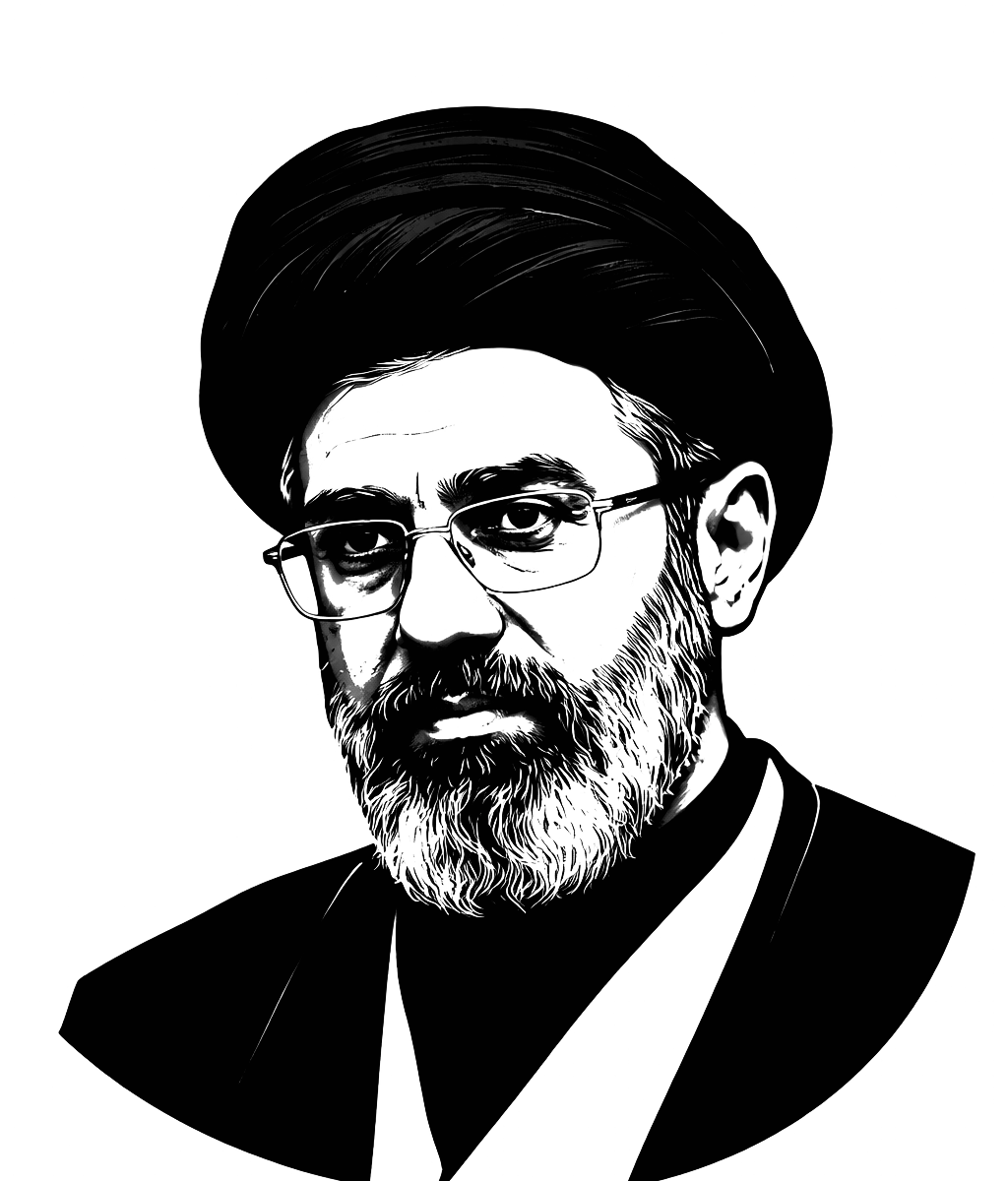
Second son of Supreme Leader Ali Khamenei (d. 2026); long operated largely out of public view. Rumoured for years to manage key patronage and liaison
channels between the Supreme Leader’s office, the IRGC, and clerical networks.
In the aftermath of the 28 February 2026 US-Israeli strikes-which killed his
father-he was appointed
Supreme Leader on 9 March 2026.
1. Origins & Formation
Mojtaba Khamenei was born in 1969 in Mashhad as the second son of Ali Khamenei. He received a clerical education and moved through hawza circles rather than formal state office, building relationships with younger clerics and security‑linked seminaries. Unlike many regime princes he did not run for parliament or hold cabinet positions; his trajectory was always towards the invisible centre of power around the Leader’s office.
2. Rise to Influence
From the 2000s onward, diplomats, insiders and dissidents alike described Mojtaba as a gatekeeper to his father and an informal handler for sensitive IRGC, Basij and intelligence portfolios. Public evidence is fragmentary, but reporting consistently places him at the intersection of:
- patronage networks inside the IRGC and Basij command,
- clerical circles in Qom and Mashhad loyal to velayat‑e faqih,
- financial and religious foundations (bonyads) aligned with the Leader’s office.
He has never held an official title that matches this influence, which allows the system to deny his role while insiders treat him as part of the core command chain.
3. Worldview & Inner Logic
Mojtaba is best read as a continuity figure whose identity is bound to his father’s project: preservation of the Islamic Republic as a security‑state theocracy under a strong Supreme Leader. His fear driver is a revolution that tears down the clerical‑security core and exposes the family to retribution. His ego driver is being recognised inside the elite as the one who can keep that core intact under extreme pressure. The available evidence suggests a hardline view on domestic dissent and a readiness to absorb high levels of external risk to preserve regime control.
4. Exercise of Power Before & After 28 February 2026
Before February 2026, Mojtaba’s power flowed from proximity to Ali Khamenei and his reported role in appointments across the IRGC, Basij and key security ministries. He functioned as an informal personnel and coordination hub, helping align military, intelligence and clerical actors around his father’s line.
The US-Israeli strikes of 28 February 2026 killed Ali Khamenei and several senior security officials; reporting also indicates that Mojtaba’s wife and likely their children died in the same campaign. In the hours and days after the attack, Mojtaba’s value to the system shifted: from gatekeeper to the Leader to one of the few figures with the relationships and information flows needed to stabilise the command chain under bombardment and mourning.
On 9 March 2026 the Assembly of Experts and security‑clerical core moved to close the succession question by appointing Mojtaba as the new Supreme Leader. That decision formalised what had been an informal power centre and locked the system into a path where the son inherits both his father’s office and the trauma of his family’s killing.
5. Historical Position
With his elevation to Supreme Leader in March 2026, Mojtaba Khamenei moves from rumoured prince to formal ruler. His historical position will turn on whether he can stabilise a war‑damaged, sanction‑hit, protest‑shaken system while carrying a personal narrative of loss-and whether the combination of dynastic succession and deep IRGC alignment hardens the Islamic Republic or accelerates its internal fractures.
6. Personal Trauma & Public Story
Analysts do not know Mojtaba’s inner emotional world, but the externally visible facts are stark: his father, and by most reporting his wife and likely children, were killed in the same US-Israeli campaign that brought him to power. That layered loss gives the leadership a powerful story to tell about sacrifice and martyrdom around his rule. How far that story is used to justify harsher repression or a long war of endurance-and how far personal loss shapes his decisions-remains a question for observers rather than something we can state from the inside.