
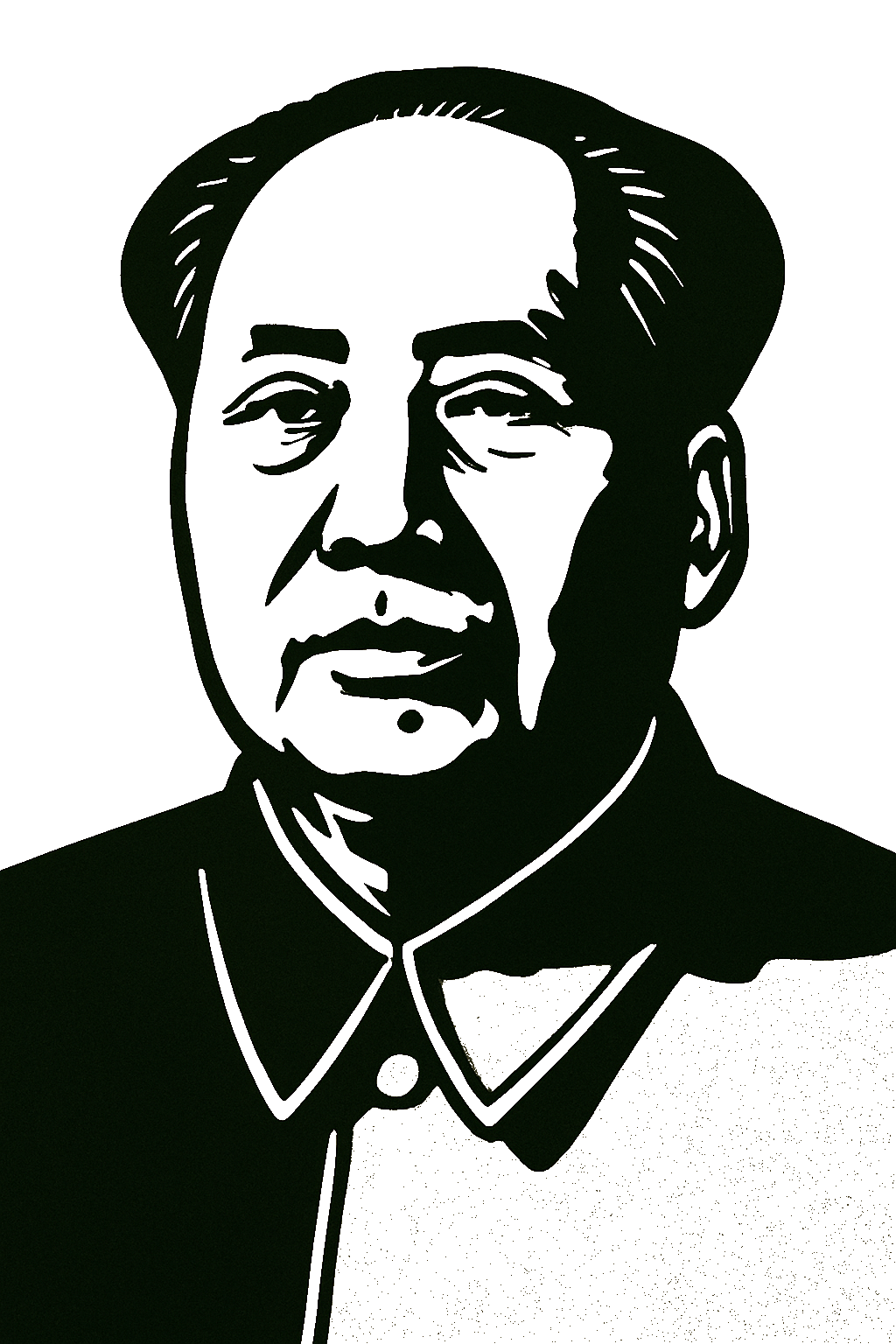
Founder of the People’s Republic of China and central figure of the Chinese Communist revolution. His rule reshaped China through mass mobilisation, ideological campaigns, war, and political upheaval.
Unified China under Communist rule, implemented social transformation and mass literacy; responsible for catastrophic campaigns that caused tens of millions of deaths.
- 1893-12-26 — Born
Born in Shaoshan, Hunan Province. - 1921 — Co-founded CCP
Co-founded the Communist Party of China. - 1935 — Long March
Led the Long March, solidifying his leadership of the Communist movement. - 1949-10-01 — Founded PRC
Proclaimed the founding of the People's Republic of China, becoming paramount leader. - 1958-1962 — Great Leap Forward
Launched the Great Leap Forward, a disastrous campaign of forced collectivization and industrialization that caused mass famine. - 1966-1976 — Cultural Revolution
Initiated the Cultural Revolution to purge political rivals and reshape Chinese society, causing widespread chaos and suffering. - 1972 — Nixon Visit
Received President Richard Nixon, signaling strategic break with the Soviet Union and rapprochement with the United States. - 1976-09-09 — Died
Died in Beijing, leaving behind a legacy of revolution, unification, and controversial radical policies.
Born in Hunan, Mao rose from organizer to paramount leader through the Long March, united front warfare, and civil war victory. After 1949, he pursued rapid industrial and social transformation. The Great Leap Forward (1958-62) precipitated famine and economic collapse; the Cultural Revolution (1966-76) dismantled institutions and persecuted elites. Internationally, Mao split with Moscow and later opened to Washington, recasting Cold War alignments. His portrait still presides over Tiananmen; his legacy remains foundational, contested, and instrumentalized.