
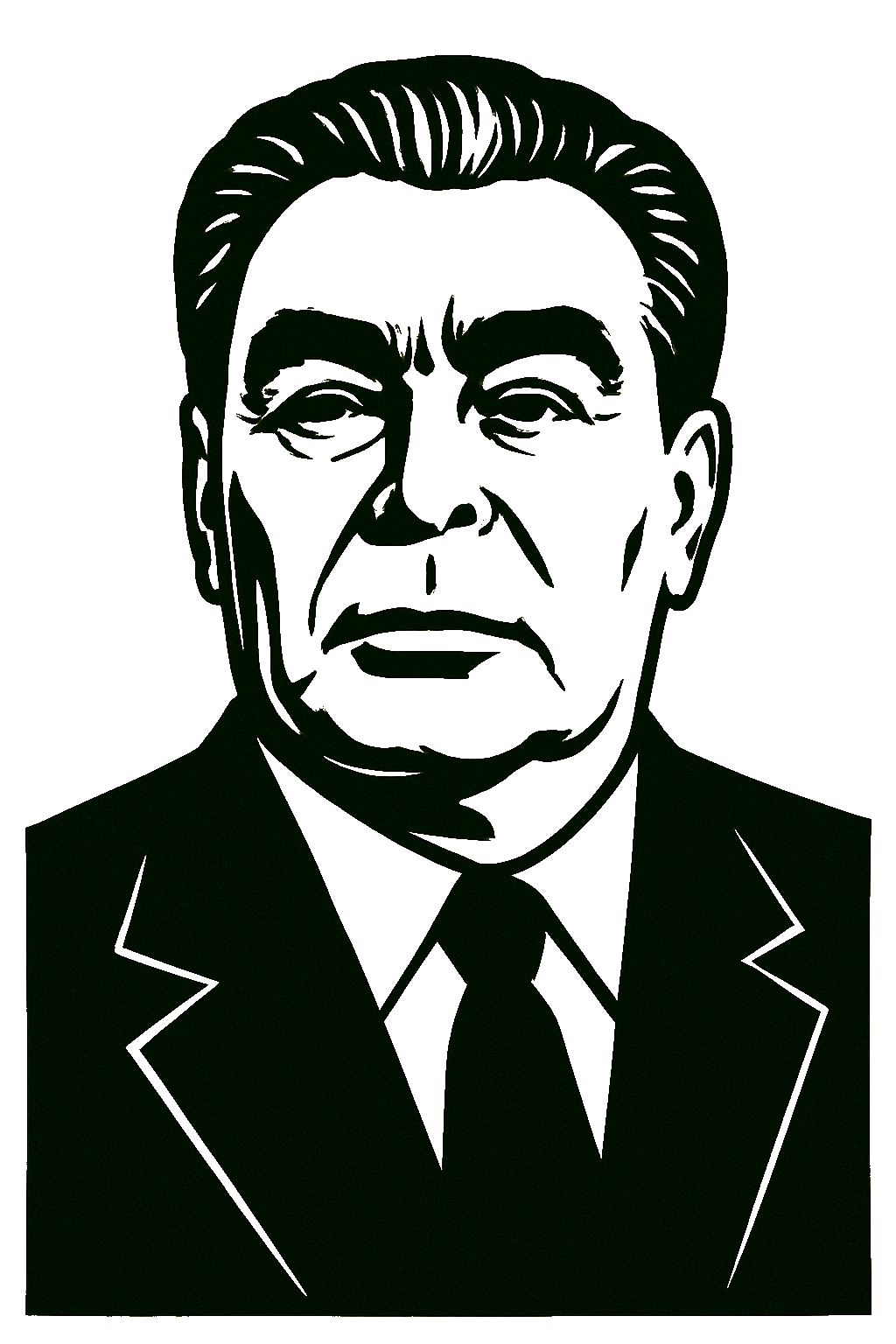
- 1906-12-19 — Born
Born in Kamenskoye, Ukraine, then part of the Russian Empire. - 1931 — Joined Organization
Joined the Communist Party of the Soviet Union (CPSU). - 1935 — Education
Graduated from the metallurgical institute in Kamenskoye and began working as an engineer and director of a technical school. - 1939 — Party Secretary
Appointed secretary of the regional party committee of Dnepropetrovsk (now Dnipro). - 1941 — Military Service
Served as a political commissar in the Red Army during World War II, achieving the rank of major general by 1943. - 1950 — First Secretary
Became First Secretary of the Communist Party of Moldavia, overseeing the sovietization of the region. - 1952 — Central Committee
Elected as a member of the Central Committee of the CPSU and a candidate member of the Politburo. - 1954 — Party Secretary
Appointed Second Secretary of the Communist Party of the Kazakh SSR, later becoming First Secretary in 1955. - 1956 — Politburo
Reelected to the CPSU Central Committee and the Politburo. - 1960 — Chairman
Became Chairman of the Presidium of the Supreme Soviet, effectively serving as the Soviet Union's head of state. - 1964 — General Secretary
Played a key role in the ousting of Nikita Khrushchev and succeeded him as First Secretary of the CPSU. - 1968 — Key Event
Ordered the invasion of Czechoslovakia to suppress the Prague Spring reforms and articulated the "Brezhnev Doctrine," asserting the right to intervene in other socialist countries to preserve communist rule. - 1977 — President
Elected President of the Supreme Soviet, consolidating his position as both head of the party and head of state. - 1979-12 — Key Event
Ordered the Soviet invasion of Afghanistan, initiating a conflict that lasted until 1989. - 1982-11-10 — Death
Died of a heart attack in Moscow.
Brezhnev replaced Khrushchev in 1964 and consolidated a system emphasizing collective leadership and strategic parity with the United States. He promoted détente, culminating in the 1972 SALT I treaty, but continued heavy investment in defense and global proxy engagements.
Relations with China remained hostile after the 1969 border clashes. The Brezhnev Doctrine justified interventions in Czechoslovakia and Afghanistan to preserve socialist control. Domestically, economic stagnation and corruption set in, defining the “Era of Stagnation.”
His long rule symbolized Soviet maturity and sclerosis – powerful yet inflexible.
1. Origins & Formation
Brezhnev was shaped by Soviet industrialisation, World War II, and the party bureaucracy. His worldview came from:
- working-class provincial upbringing
- engineering training
- wartime command
- postwar administrative promotion
Unlike Khrushchev’s emotional populism or Mao’s revolutionary passion, Brezhnev’s psychology was bureaucratic: order, hierarchy, predictability. In the emotional logic you described earlier – fear, duty, ego – Brezhnev’s dominant driver was fear of instability. He grew up in the chaos of early Soviet rule and believed the USSR’s survival depended on freezing change, not accelerating it.
2. Rise to Power
Brezhnev rose through:
- party loyalty
- wartime hero credentials
- administrative competence
- Khrushchev’s patronage (ironic, given he later replaced him)
By 1964 he led the collective coup that removed Khrushchev. Brezhnev framed himself as the “safe, steady alternative” after Khrushchev’s chaotic reforms.
The system rewarded:
-
stability
-
predictability
-
loyalty networks
-
and Brezhnev built his entire power base on these three elements.
3. Worldview & Inner Logic (BH Motive Grid)
Power Orientation: Bureaucratic, conservative, stability-first. He saw leadership as maintaining balance, not shaping a visionary project.
Fear Vectors:
- fear of internal instability
- fear of reform leading to collapse
- fear of US technological dominance
- fear of losing geopolitical influence
Identity Logic: The USSR as a superpower that must never show weakness. Empire as identity.
Moral Logic: Status-quo consequentialism. Brezhnev believed the moral duty of leadership was preventing chaos – even at the cost of stagnation.
4. Exercise of Power
Brezhnev presided over:
- the largest peacetime military build-up in Soviet history
- limited diplomatic engagement (détente, SALT I)
- suppression of dissent (Solzhenitsyn, Sakharov)
- economic slowdown and structural decay
- the 1979 invasion of Afghanistan
His leadership style:
- slow
- cautious
- reliant on patronage
- resistant to innovation
- deeply ceremonial
Internally, he froze the system so tightly that by the early 1980s:
- the economy stalled
- corruption blossomed
- gerontocracy replaced meritocracy
“Stability of cadres” became paralysis of cadres.
5. Moral Ledger (Grey-Zone Analysis)
Constructive:
- reduced risk of nuclear war through détente
- built conventional military parity with the US
- avoided mass terror
- maintained geopolitical influence
Destructive / Complicit:
- entrenched authoritarian stagnation
- supported invasions and interventions across Eastern Europe
- dismantled reform movements in Czechoslovakia (1968)
- allowed economic decay that later made collapse inevitable
- entered Afghanistan, draining morale and finances
Brezhnev was neither monstrous like Stalin nor reformist like Gorbachev. He was a stabiliser whose stability became erosion.
6. Historical Position & Legacy
Brezhnev’s era (1964-1982) is remembered as:
- stable
- predictable
- declining
- comfortable for elites
- stagnating for society
It set the stage for:
- the economic crises of the 1980s
- Gorbachev’s desperate reform attempts
- the eventual collapse of the USSR
Modern Russia under Putin selectively echoes Brezhnev:
- emphasis on stability
- nostalgia for superpower parity
- centralised control
- suspicion of reform
Yet Brezhnev’s failure to modernise remains a cautionary lesson: an empire that chooses stability over innovation eventually breaks.