
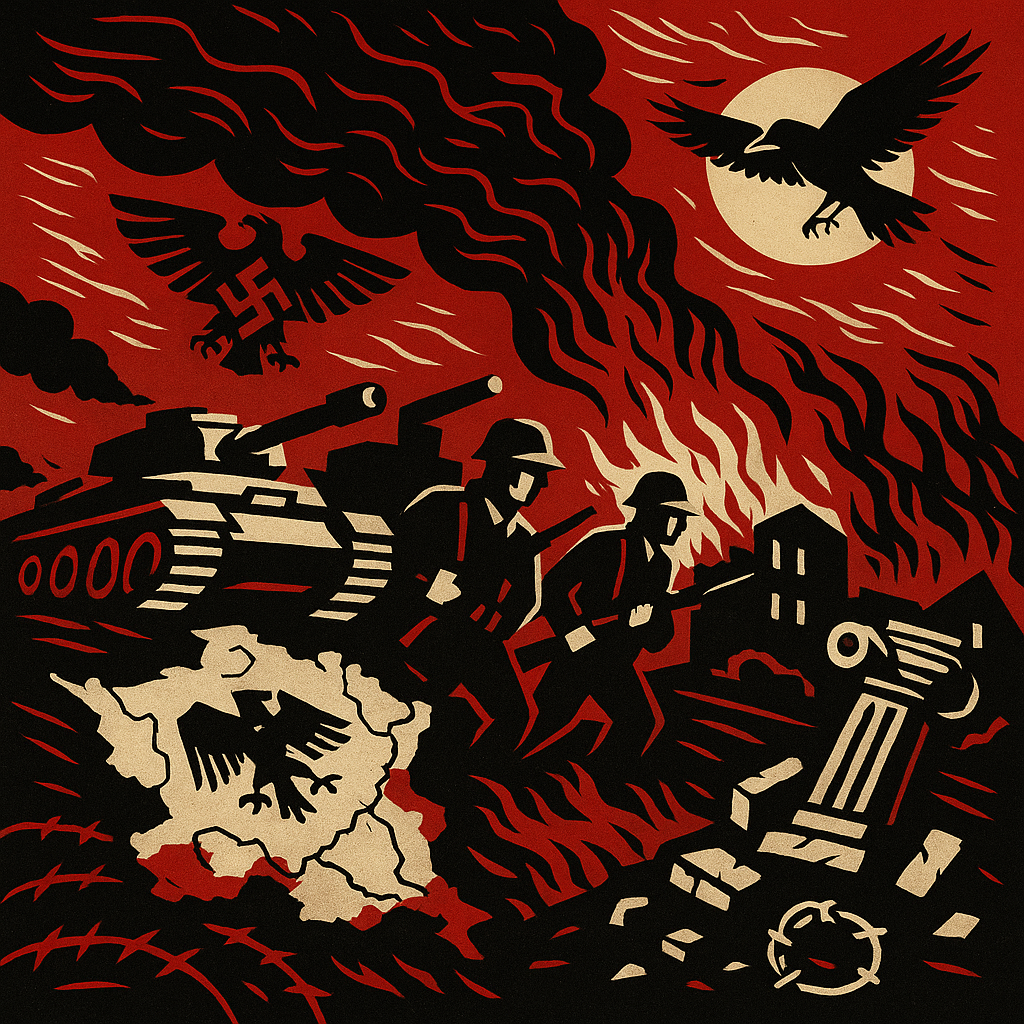
June 1941
In June 1941, Nazi Germany launched Operation Barbarossa, the largest military invasion in history. Its aim was the conquest of the Soviet Union. Its result was the beginning of a long, brutal war of annihilation on the Eastern Front.
Background
Signed in 1939, the Molotov-Ribbentrop Pact was a fragile truce between Hitler and Stalin. But behind the pact, Hitler always planned an eastward war of conquest. On June 22, 1941, over three million German troops crossed into Soviet territory without warning.
The invasion shattered the non-aggression agreement. Soviet cities like Kyiv, Minsk, and Smolensk were overrun in the first weeks. Civilians and soldiers alike suffered under the Nazi scorched-earth policy and systematic massacres. The front extended over 2,900 kilometers – a scale previously unimaginable.
Stalin, caught off guard, struggled to respond in the opening phase. But Soviet resistance soon stiffened, especially under generals like Georgy Zhukov. The brutal defense of cities like Leningrad and Moscow began to slow the advance.
Legacy
- Marked the start of the Eastern Front – the most lethal theater of WWII
- Initiated the genocide of Jews in Soviet territories
- Cemented mutual hatred between Germany and the USSR
- Set the stage for Stalingrad, the Soviet counteroffensive, and postwar Soviet dominance in Eastern Europe
Key Moment
Perspective & Relations
Narratives
| molotov-ribbentrop-pact | Operation Barbarossa shattered the Molotov-Ribbentrop calculus and became the defining trauma of the Soviet twentieth century: a brutal defensive war, existential in both scale and meaning. | |
| soviet-union | Operation Barbarossa shattered the Molotov-Ribbentrop calculus and became the defining trauma of the Soviet twentieth century: a brutal defensive war, existential in both scale and meaning. | |
| nazi-regime | Germany launched Barbarossa as a racial-ideological war aimed at destroying Bolshevism, enslaving Slavs, and annihilating Jewish communities across Eastern Europe. | |
| european-theatre-ww2 | Barbarossa was the decisive shift in Europe’s war trajectory: it set in motion the Red Army’s advance, the eventual collapse of the Reich, and the long-term East-West division that shaped Europe for the next 80 years. |