
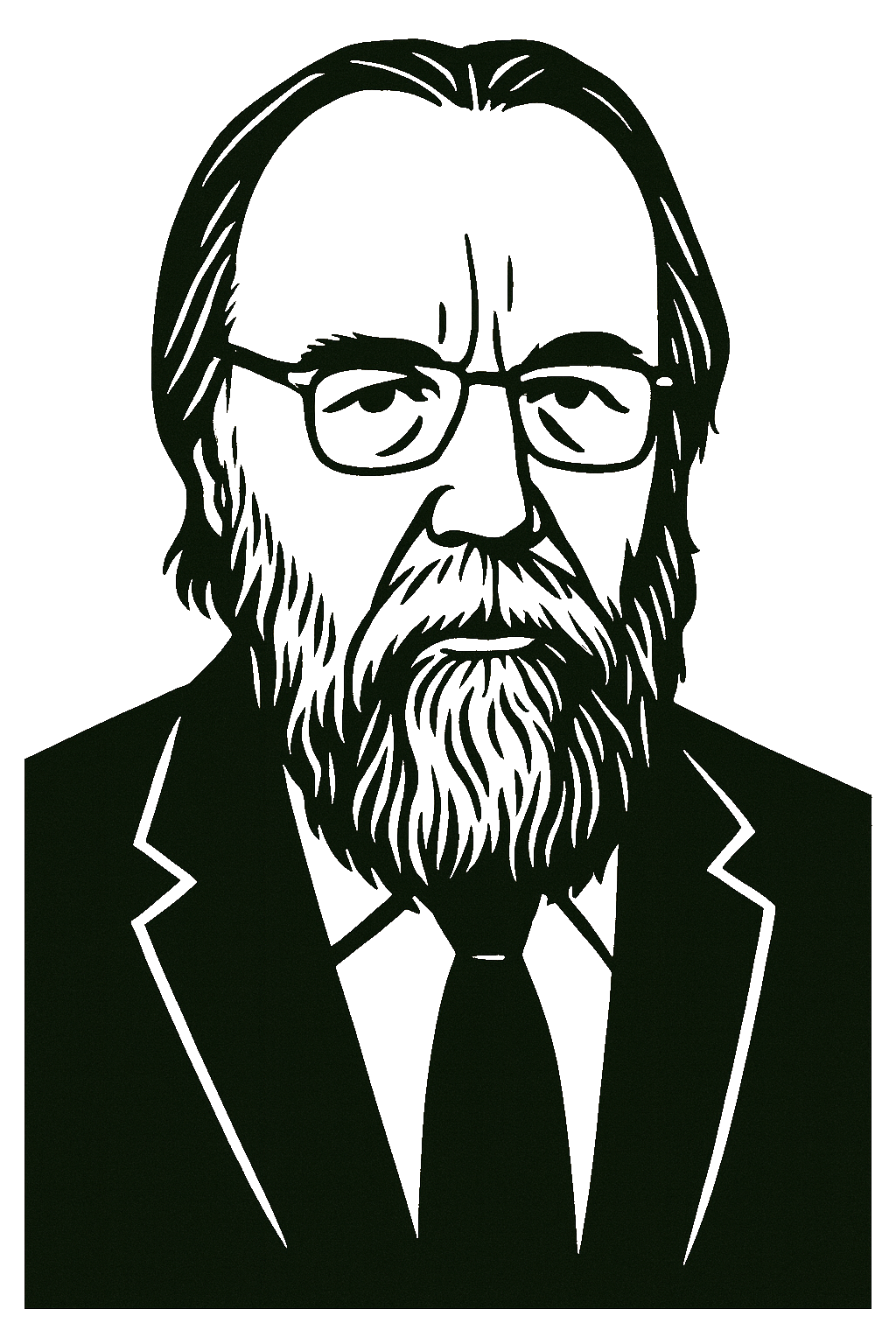
for his advocacy of Eurasianism – a geopolitical doctrine arguing for Russia as
a distinct civilization destined to counter Western liberal influence. Though not
an official policymaker, his ideas have circulated around nationalist, traditionalist,
and neo-imperial currents inside Russia since the 1990s.
Alexander Dugin emerged during the turbulent post-Soviet 1990s, a period defined by economic collapse, identity fragmentation, and a search for new national narratives. He positioned himself as a theorist of Russia’s civilizational destiny, drawing from a wide intellectual field: classical geopolitics, Orthodox mysticism, European traditionalism, and anti-liberal philosophy. This eclectic foundation gave his work both ideological breadth and ideological instability – a mixture of scholarship, political prophecy, and metaphysics.
His central idea, Eurasianism, argues that Russia is neither wholly European nor Asian but a unique civilization tasked with counterbalancing American and Western liberal power. In Dugin’s logic, geography becomes destiny: land powers oppose sea powers, identity opposes universalism, tradition opposes modernity. This worldview resonated inside nationalist and hard-line circles during the state’s ideological vacuum of the Yeltsin era.
Dugin never held formal political power, yet his vocabulary and frameworks migrated into parts of Russian strategic thinking, especially after 2014. His writings provided language for a Russia that saw itself in civilizational struggle, not just geopolitical competition. The idea of the “Russian world,” confrontation with the West, and the need for a multipolar order found echoes in state messaging, even when he was not directly consulted.
His later years were marked by increasing radicalism: stronger anti-liberal framing, apocalyptic language, and a call for cultural and spiritual resistance to Western influence. The 2022 war in Ukraine intensified his visibility; his daughter’s death in a car bombing in 2022 placed him once again in international headlines. Yet within Russia his real influence remains debated: some see him as a marginal ideologue amplified by Western media, others as a symbolic mirror of deeper nationalist currents within Russian political culture.
Dugin’s historical significance lies not in formal authority but in providing metaphors, symbols, and conceptual tools for a Russia searching for identity after empire, after communism, and after post-Soviet liberalism. Whether he shaped the state or merely echoed its psychological currents, his presence tells us something essential about the intellectual landscape surrounding contemporary Russian power.