
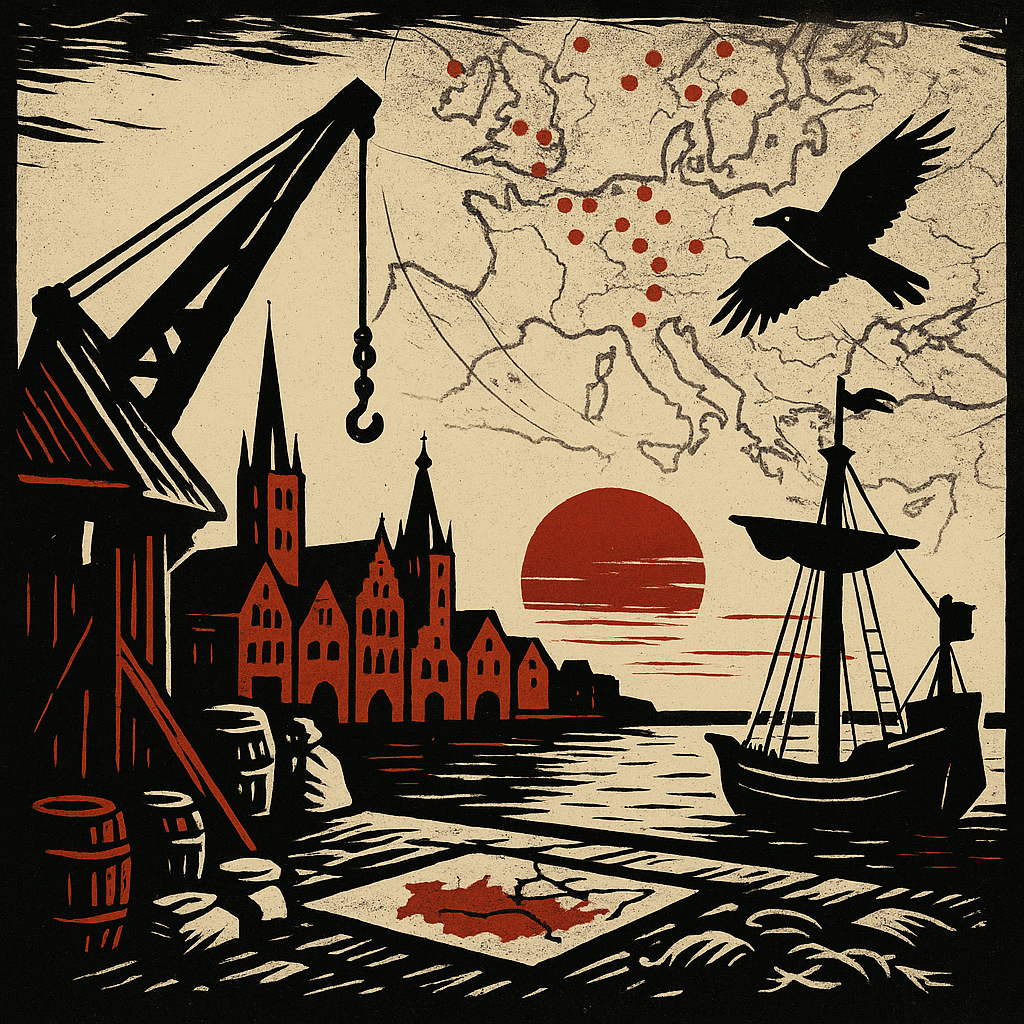
How supply chains and constraint, will shape the global struggle
I. Three Visions of Expansion
Before the lines of conflict were drawn, the world was seen through the lens of reach.
Alfred Thayer Mahan envisioned power in sea lanes — the ability to project strength beyond sight. Friedrich Ratzel and later Haushofer interpreted space as organic necessity — Lebensraum as the natural hunger of a growing nation. The railway, unromantic but essential, gave empires inland arteries. Steel replaced sails. Coal replaced conquest.
Each vision sought control. Not only over land, but over how land moved — what could be extracted, mobilized, secured. They were not merely military doctrines. They were metaphysical blueprints: maps of how empires understood themselves.
II. From Mackinder’s Pivot to Today
Then came Mackinder. In 1904, he gave voice to a theory that reoriented the axis of geopolitical thought. His Heartland theory didn’t just argue for geography. It argued for inversion: that the future belonged not to maritime empires, but to those who could consolidate the heartland — the pivot zone, the inaccessible interior.
He saw the world not as a sea to command, but as a core to hold. Many came after him – though his thesis is still being used in geopolitical thinking.
Today, we no longer conquer space. That was at least the general thought until recently – at this moment we experience a revival of Empire-thinking but more for personal (ego) reasons. The actual thesis is more aligned on innovation and technology. Whoever has the most advanced technology rules. The offspring of it is visible in a competition on getting Rare Earth for example.
III. The Philosophy of Constraint
Concept
But what do we see, taking a step back. Geopolitics is not winning a race on technology. There will always be innovation. It is not just territory, but continuity. It is not just dependence by political or military power (with spheres of influence) but by a network of Supply Chain Assets. Having flow, constraints and pressure points. This is the new world.
- Imagine Technology and AI: Semiconductors pass from Eindhoven to Taiwan to California. To the world. If Eindhoven (ASML) is hit and taken out, the whole world experiences consequences. There is no alternative – a constraint. Who would take such an action? The one that outgrows first – by alternative or innovation. Or the one that survives best without it
- Think of Water Supply: no matter the situation or time – it is priority. Pakistan relies on the Kashmir Mountains. A pressure point for Israel is Mount Hermon. The Alps are directly connected to big corridors in Europe
- It may take another 100 years before Willem Barentz idea of a Northern Route becomes reality. When it does it becomes a Pressure Point. A reason for China to eye the Northern Mantsjoeria and further north
- Demographic change in the future can or will lead to a change of welfare. Population shifts towards South-East Asia, and then to African Subsaharan areas. Europe could be at the Global Network’s Center – a major Constraint, Pressure Point and danger zone
Constraint is not weakness. It is terrain. So are Pressure Points. What happens if becomes the grammar of power:
- What happens if this corridor closes?
- What happens if this narrative shifts?
- What happens if we lose this friend?
This is not about panic. It is about design. Constraint does not prevent strategy — it gives it shape. It gives opportunity.
Power today belongs not to those who stand above, but to those who stand between.
This Is the Future.
Mind you. We also are in a deep global moral crisis. We lost the Common Narrative and we need it back. Common Sense, Common Truth.
Another constraint.