
Asylum Migration
Article Content
Introduction
Asylum migration represents the search for safety and protection by individuals fleeing conflict, persecution, and human rights violations. It is a complex process governed by international and national laws, involving distinct stages and pathways. This article provides a comprehensive overview of the asylum migration process, its legal frameworks, and the challenges faced by asylum-seekers worldwide.
What is Asylum Migration?
Asylum migration refers to the movement of individuals seeking international protection from threats in their home countries. These individuals may face persecution based on race, religion, nationality, political opinion, or membership in a particular social group.
Key Definitions
- Asylum-Seeker: A person who has applied for protection but whose claim is yet to be decided.
- Refugee: Someone recognized under the 1951 Geneva Convention as having a well-founded fear of persecution.
- Complementary Protection: Granted to individuals who do not qualify as refugees but cannot return to their country due to risks such as torture or inhumane treatment.
- Temporary Protection: Short-term status provided during mass displacements, such as for Ukrainian refugees in 2022.
The Asylum Process: Steps and Pathways
The asylum process is a journey with distinct stages and optional pathways:
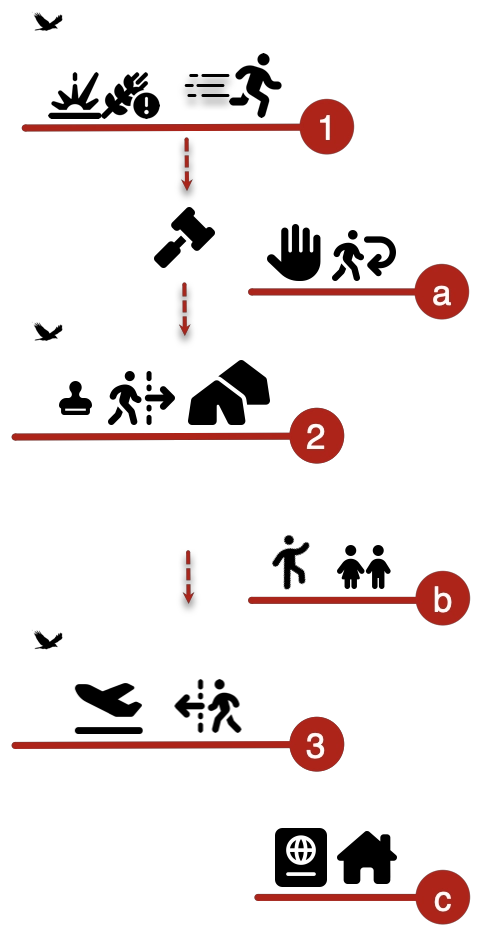
Main Steps
1. Application Stage (Asylum-Seeker): The individual submits a formal application for international protection.
2. Protection Status Granted: If the claim is approved, the individual receives refugee status or complementary protection, gaining rights such as residence and limited work opportunities.
3. Return: In ideal circumstances, individuals voluntarily return to their home country when conditions improve.
Side Pathways
• Sequential Applications: After a rejection, individuals may appeal or file a new claim.
• Family Reunification: Ensures families separated by displacement can reunite under certain conditions.
• Naturalization: Provides long-term residents with the opportunity to become citizens, integrating fully into their host country.
Special Cases
• Irregular Stay: Refers to individuals who cannot return home due to safety or legal obstacles but remain without formal status.
• Temporary Protection: A fast-track mechanism for mass displacements, often without a full asylum process.
• Resettlement: Relocation to a third country when return or integration in the host country is not feasible.
International and National Frameworks
The asylum process operates within a dual framework of international standards and national implementations.
International Law
The 1951 Geneva Convention and its 1967 Protocol form the backbone of refugee protection, establishing:
• The definition of a refugee.
• The principle of non-refoulement—prohibiting the return of refugees to countries where they face danger.
Other key international agreements include:
• UNHCR Guidelines: Offering best practices for asylum processes.
• Regional Frameworks:
• The Dublin Regulation (Europe): Assigns responsibility for asylum claims within the EU.
• The OAU Convention (Africa) and the Cartagena Declaration (Latin America): Tailored to regional challenges.
National Variations
While international law sets baseline standards, countries interpret and implement them differently. For example:
• Sweden: Offers robust social support and integration programs.
• Hungary: Implements stricter asylum policies with limited rights for applicants.
Real-Life Examples
• Syrian Refugees in Turkey:
• Status: Temporary Protection under Turkey’s geographical limitation policies.
• Challenges: Limited access to citizenship and permanent residence.
• Resettlement Programs:
• Syrians in Jordan relocated to countries like Germany or the U.S., showcasing international cooperation in sharing responsibility for refugees.
Monthly Insights and Reports
To provide up-to-date information on asylum trends, we publish monthly reports covering key statistics and developments. For example:
• December 2024 Report: Highlights a 10% rise in asylum applications within the EU, with Syria and Afghanistan as the top countries of origin.
Explore our monthly insights here.
Frequently Asked Questions (FAQs)
1. What is the difference between refugee status and complementary protection?
2. Can asylum-seekers work in their host country?
3. What happens if an asylum application is rejected?
4. How does family reunification work in the asylum process?
References
- 1. United Nations High Commissioner for Refugees. (2024). UNHCR Guidelines on International Protection. Retrieved from https://www.unhcr.org/
- 2. European Union. (2024). Dublin Regulation Overview: Assigning Responsibility for Asylum Claims. Retrieved from https://europa.eu/
- 3. Smith, J. (2022). Asylum and Migration Trends in Europe: A Statistical Analysis. Journal of Refugee Studies, 34(3), 45-67. Available at https://jrs.com/studies