
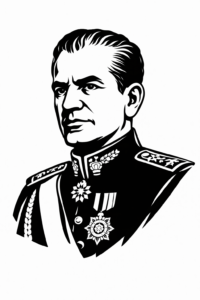
- 1919-10-26 — Born
Born into the Pahlavi dynasty established by his father Reza Shah. - 1941-09-16 — Ascended to Throne
Became Shah of Iran after British and Soviet forces forced his father's abdication during World War II. - 1963 — White Revolution
Launched the White Revolution with land reform, literacy corps, and enfranchisement of women, but also alienated landowners, clerics, and traditional elites. - 1979-02-11 — Overthrown
Deposed during the 1979 Islamic Revolution after 38 years in power. - 1980-07-27 — Died
Died in exile in Egypt.
1. Origins & Formation
Born into the Pahlavi dynasty established by his father Reza Shah, Mohammad Reza ascended
the throne during World War II after British and Soviet forces forced his father’s abdication.
His worldview fused admiration for Western industrial power with a paternalistic vision of
state-led development.
2. Rise to Influence
Over 38 years in power, the Shah consolidated control through a modernising bureaucracy,
expanded armed forces, and the creation of SAVAK. The White Revolution (1963) attempted
socio-economic transformation-land reform, literacy corps, enfranchisement of women-but also
alienated landowners, clerics, and traditional elites.
3. Worldview & Inner Logic
Fear driver: National disintegration and foreign interference.
Ego driver: Modernising monarch; personal identification with Iran’s destiny.
Belief driver: Secular nationalism, industrial progress, Western alignment.
Identity driver: Guardian of Iranian independence and continuity.
4. Exercise of Power
The Shah centralised decision-making, used oil revenues to build industry and military power,
and backed rapid urbanisation. His reliance on technocrats and security services created both
modern institutions and resentment. The regime’s repression and inequality widened the gap
between state and society.
5. Conflicts & Opponents
The Shah faced resistance from clerics, Marxist guerrillas, merchants, students, and
disenfranchised rural populations. His circle of advisers grew increasingly insulated. The
1978-79 revolutionary wave overwhelmed state capacity despite military superiority.
6. Achievements & Failures
Achievements: Modern infrastructure, industrial expansion, expanded education,
strengthened national army, enhanced geopolitical stature.
Failures: Political exclusion, concentration of wealth, suppression of dissent, failure
to perceive societal backlash, and inability to reform during crisis.
7. Historical Position & Legacy
The Shah remains one of the most contested figures in Iran’s history. His downfall reshaped
the Middle East and opened the path to the Islamic Republic. His legacy is paradoxical:
modernisation without political openness created the conditions for revolutionary rupture.