
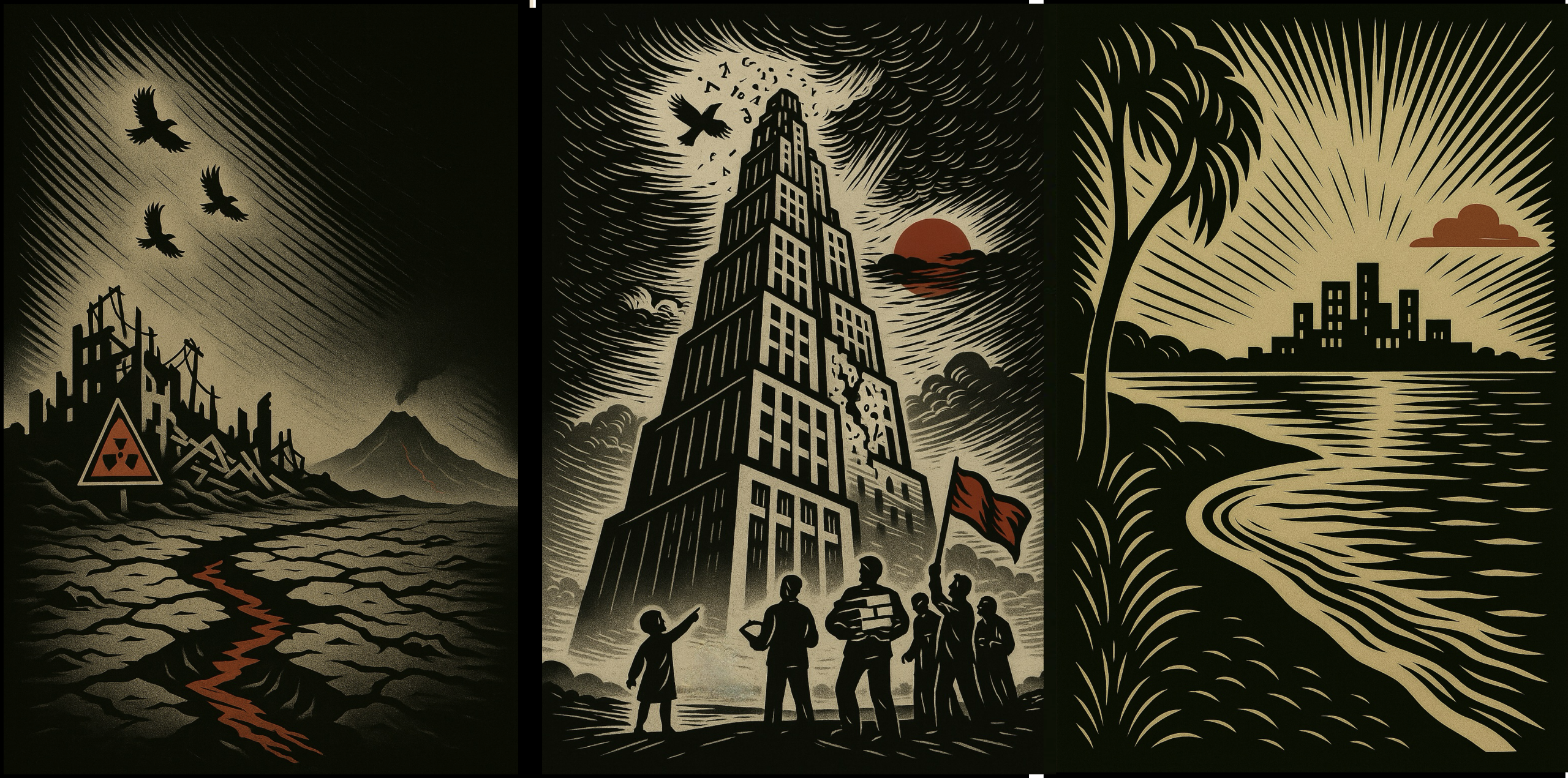
Triptych – Babel Variant I
This image began as one tower. A sketch for the article Return to Babel — where language, identity, and belonging fracture under the weight of history. But like the story of Babel itself, it refused to remain singular.
“If they are one people with one language, nothing will be impossible for them… So the Lord confused their speech and scattered them over the face of the earth.”
— Genesis 11 (paraphrased)
The Tower of Babel is usually told as a warning: about pride, confusion, collapse. But it also echoes something older. In the creation command, humanity was told to go forth, multiply, and fill the earth. The scattering of languages wasn’t the end of culture. It was its beginning.
—
What you see here is the evolved form: a triptych. The Tower stands in the center — proud, haunted, already cracking. Around it, two futures unfold.
To the left: the barren lands. Ruins of ambition. Crows circling radioactive dust. The end of a tower built only for glory.
To the right: the promised land. A sunrise city. Calm waters. A future still open — not built on fear, but belonging.
This image is not prophecy. It is invitation. A choice that repeats through history. To build as Babel did — or to rebuild from the scattering.
It began with one image, just as Babel began with one language. But now it speaks in three: past, present, and possibility.
Related Articles

Return to Babel: Language, Identity, and Belonging
How identity is filtered — not by law, but by design – and what it means to belong

Empire Logic: How Russia Uses Borders, Identity, and Delay
Russia does not need to occupy a country to control it. It only needs to prevent resolution. From Transnistria to Crimea, from narrative warfare to financial systems, Empire Logic shows how modern power is held — not through conquest, but through structural denial.